
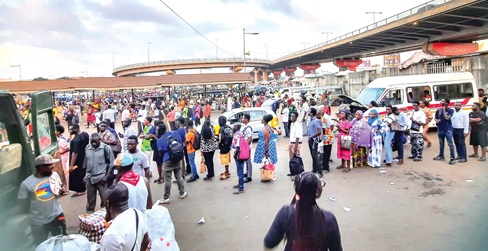
Public transport fares will go up by eight per cent effective Saturday, September 26, 2026, the first official increment in fares since a 15 per cent decrease in May 2025.
The announcement by the Ghana Private Road Transport Union (GERTRUDA) and the Ghana Road Transport Coordinating Council (GRTCC) comes after some commercial transport operators began to implement arbitrary fare increases on certain routes, citing rising operational costs.
Official statistics suggest that over 80 per cent of urban residents rely on public transport for daily commutes, with a possible wider impact on prices of goods and services.
The new fares, according to a statement by the GPRTU and GRTCC, were arrived at following consultations between the Ministry of Transport and commercial road transport operators held from September 8 to 22, 2026.
The adjustment will affect shared taxis, intra-city “trotro” services, inter-city long-distance transport and haulage services.
Commuter data
The eight per cent increase in transport fare will impact a huge number of commuters in the country.
Official data say 84 per cent of passenger trips in local cities are by public transport.
A 2017 national urban mobility survey revealed that 84 per cent of passenger trips in cities are made by public transport and 15 per cent by private cars.
The survey found that approximately 84 per cent of all daily passenger trips leave or enter the Accra Ring Road area, for example, via public transport.
It revealed further that public transport buses, commonly referred to as “trotros”, alone account for 70 per cent of passenger trips in the country.
New fares
The increase will be calculated on the approved transport fares which took effect on May 24, 2025.
For intra-city “trotro” services, a fare of GH¢5 will increase to GH¢5.50, while GH¢10 will go up to GH¢10.80.
A GH¢15 fare will rise to GH¢16.20, while GH¢20 will increase to GH¢21.60.
For shared taxis, a journey of up to one kilometre will increase from GH¢1.70 to GH¢1.90, while journeys of up to four kilometres will rise from GH¢2.60 to GH¢2.90.
Whereas a journey of up to 20 kilometres will increase from GH¢8.50 to GH¢9.20, journeys of up to 40 kilometres will rise from GH¢18.70 to GH¢20.20.
For inter-city services, a GH¢25 fare will increase to GH¢27; GH¢50 to GH¢54; GH¢100 will become GH¢108, while a GH¢300 fare will increase to GH¢324.
Rising costs
The GPRTU and GRTCC said the adjustment took into consideration changes in the ex-pump prices of petroleum products, spare parts, vehicle maintenance and other operational costs.
They said the factors were weighed against the financial challenges facing drivers and commuters.
Indeed, fuel prices have increased considerably this year, triggering agitations by private transport operators for increases.
The last adjustment in public transport fares was the 15 per cent downward review in May last year.
It followed an agreement between transport unions and the Ministry of Transport on the basis of decreasing fuel prices and the appreciation of the Ghana cedi.
At the time, petrol, for instance, experienced a sustained drop in price from around GH¢15 per litre in January 2025 to less than GH¢12 per litre, reaching GH¢9.99 per litre at some pumps until Iran’s war with the United States and Israel started in February this year.
The transport unions also acknowledged the government's intervention on the price of diesel, saying it has helped to moderate the extent of the increase.
Compliance
The GPRTU and GRTCC have consequently directed all commercial transport operators to comply with the approved fares and display the revised fare schedules at loading terminals and stations.
They said operators who charged fares above the approved rates would face appropriate sanctions.
The joint statement was signed by the General Secretary of the GPRTU, Godfred Abulbire, and the General Secretary of the GRTCC, Emmanuel Ohene Yeboah.
The two organisations said they would continue to engage the government and other stakeholders on issues affecting the road transport industry and the travelling public.
The Public Relations Officer (PRO) of the GPRTU, Samuel Amoah, told the Daily Graphic separately that the new fare schedule would be issued tomorrow before it takes effect on Saturday.
On reports of unauthorised fare increases, he said the GPRTU was working with transport unions, the Ministry of Transport and the Ghana Police Service to ensure that drivers belonged to recognised unions to enable the GPRTU to regulate fares and curb inappropriate charges.
Operators, commuters react
Appiah K. Adomako, the Director for West Africa Regional Centre at CUTs International, a think tank focused on consumer sovereignty, said the fare increase was necessary to enable commercial transport operators to meet rising operating costs and maintain their vehicles.
He, however, said the adjustment would put additional pressure on households already struggling with the high cost of living.
Mr Adomako called for a transparent fare-adjustment formula based on the full cost of operating commercial vehicles, including fuel, spare parts, maintenance, insurance, labour, exchange-rate movements and passenger capacity.
He also urged the government to improve roads, support affordable vehicle financing and review taxes and charges on public transport to reduce operating costs.
Isaac Kusi, a worker at the TUC Station in Accra, said the eight per cent increase was lower than what drivers had generally expected.
He added that some drivers had anticipated an increase of about 30 per cent because of the rising cost of engines and spare parts.
He said some drivers had resorted to operating as “floating” drivers because they considered the fares approved at the stations inadequate, resulting in a shortage of vehicles at the station.
A trotro driver, Kwame Quansah, said he preferred operating as a floating driver because it gave him greater flexibility in determining fares, adding that some drivers had already increased their fares before the official announcement.
“I like floating because it is easier. With the station, I have to follow a long queue before I can go for a trip, but with the floating schedule, I can go more than twice and charge any fare due to how I like and still meet my sales per day,” he said.
GPRTU assures compliance
A General Manager of O.A. Travels at the Kwame Nkrumah Circle Interchange enclave, Michael Owusu, said operators had no choice but to charge the fares approved by the GPRTU from Saturday.
“Our bosses at the union have not yet issued the new fares to us. However, even though we may not like the increase due to its low nature, we have no choice but to implement it when it is issued,” he stated.
Passenger concerns
For some passengers, the official increase came as little surprise.
Mercy Odoi, a passenger, said drivers had already increased fares on some routes, and, therefore, she was not expecting a significant additional increase from Saturday.
“Drivers are already loading straight, and charge the optimum fares no matter where you alight. So, from Saturday, the fare increment will be no surprise to us,” she said.
