
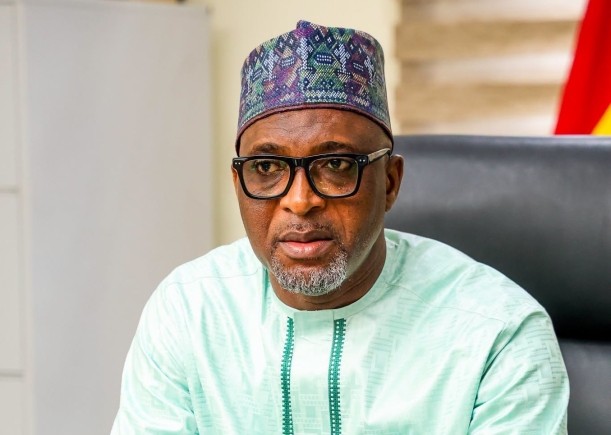
All active firearm licences in Ghana have been suspended with immediate effect, the Minister of the Interior, Muntaka Mohammed Mubarak, has announced.
It follows what he said was the use of firearms to commit suicide by three affluent persons in Ghana in the last three months.
All firearm holders are therefore required to undergo fresh mental health screening and training in firearm usage before their licences are going to be renewed, the minister said.
He was speaking in a radio interview monitored by Graphic Online on Accra-based Joy FM on Tuesday morning [June 23, 2026].
The minister had been called on telephone for a reaction on the withdrawal of the operating licence of private security company, Kantanka Security Services in relation to the shooting incident last Sunday, at the residence of Israel Kwadwo Safo Akofena, which resulted in an injury to his sister, Sarah Adwoa Safo, also a former Member of Parliament for Dome Kwabenya.
The family is currently engaged in a dispute over inheritance following the death of their father, Apostle Kwadwo Safo in September 2025.
Speaking in the radio interview, Mr Muntaka Mohammed Mubarak indicated he was going to address a press conference on the new development on the suspension of all licences until a fresh mental health screening is done for all gone holders.
The new requirements include compulsory mental health assessments, drug tests and practical firearms handling training as part of a new licensing process introduced, he said.
The Minister said the measure was intended to strengthen public safety and address weaknesses identified in Ghana's firearm licensing system.
He said recent cases in which licensed firearm owners had used their weapons to take their own lives had exposed shortcomings in the existing licensing regime.
"In the last three months, we've seen three affluent persons who have used it to commit suicide," Mr Muntaka said.
"We are realising that what was lacking is that we don't do mental health checks. We don't do drug tests. We also don't train people properly," he added.
Mr Muntaka said the current licensing process mainly requires a written application and background checks, but does not include compulsory psychiatric assessments, drug screening, or practical firearms training.
"I, Muntaka, hold a gun. When I was going to register it, they didn't do any mental health check on me. They didn't check whether I'm on drugs. I've not been trained to be sure that I even know how to handle it," he said.
The Central Firearms Registry of the Ghana Police Service requires applicants to be of good character and mentally sound before licences are issued. The process does not currently require formal mental health assessments, drug screening, or practical shooting tests.
Under the new arrangement, all existing licence holders must undergo psychiatric assessments by the Mental Health Authority, drug screening by the Narcotics Control Commission, and practical firearms handling training at a police-approved shooting range before their licences are renewed.
Mr Muntaka said the exercise would begin on Wednesday, June 24, 2026.
"Immediately, we have a training shooting range at Tesano. We'll have the Narcotics Control Commission that is ready to do the drug test. And then we have the Mental Health Authority that is ready to do mental health.
"So maybe from tomorrow, you can come back. We'll take you through the process," he said.
He said the exercise would not be limited to Accra, explaining that regional police commands had been directed to identify locations where firearm holders could receive the required training.
"The police are in every region. I'm activating them. In every region, at least, we should try and designate a place where the private citizen can come, and the police will train them," he said.
Mr Muntaka added that discussions were underway with private operators interested in establishing certified shooting ranges to support the exercise.
Explaining the legal basis for the decision, Mr Muntaka said the law gives the Minister for the Interior the authority to suspend firearm licences whenever public safety is at risk.
"The law mandates me, even when I give you a licence, at any time that I think it could be a threat to public safety, I can withdraw it," he said.
He said the decision was influenced by the recent suicides involving licensed firearm owners and the Kwabenya incident in which armed personnel of a private security company were found carrying registered sidearms contrary to the regulations.
"I just realised that I want to check the law as the Minister for Interior for the sake of the public, to create public safety," he said.
"Normally it lasts for one year. Rationally, someone will say there was no way until December when it expires and people are going to renew it. Then you kick in. We have seen too many of these suicides."
Mr Muntaka also reminded private security operators that firearms licensed to individuals for personal protection could not legally be used for private security operations.
"The individual can register a weapon and use it for personal purposes, personal protection. But that weapon cannot be transferred to be used for the purposes of a private security company," he said.
"If you go, because you are private security, then you go behind and register a gun individually in your name that you are going to use it for protection, and then you end up using it in your private security organisation, you are infringing on the law. I will definitely be coming after you."
The minister further announced that firearms collected during the national gun amnesty conducted between December 2025 and January 2026 would be publicly destroyed on July 9, 2026.
He said he would address a press conference later on Tuesday, June 23, 2026, to provide details of the new licensing arrangements.
The national gun amnesty resulted in the recovery of more than 4,000 firearms from civilians across the country.
The Ministry for the Interior has been reviewing Ghana's firearm licensing system since Mr Muntaka assumed office.
In November 2025, the ministry announced a six-week national gun amnesty to encourage the voluntary surrender of unregistered firearms without prosecution. In March 2026, Mr Muntaka announced that the issuance of new firearm licences had been slowed while the Central Firearms Registry was being digitised.
The latest directive suspends all existing firearm licences and makes mental health assessments, drug screening and practical firearms training compulsory before licences are renewed.
