
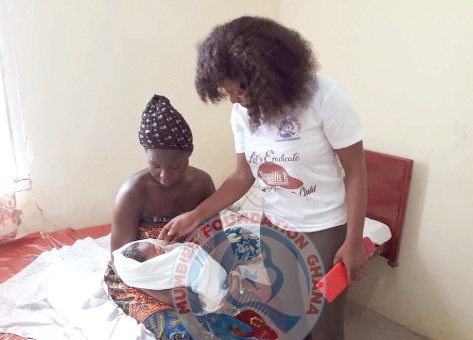
Angelina Mensah, 36, once lived each day with an unending fear of dying and leaving behind her little children after her husband died of hepatitis B infection at Sankor, a fishing community at Winneba.
But today, the single mother of two children, aged two and 13, has hopes of living longer to take care of her children, unlike her husband, who died at 38 from the silent killer disease in August 2024.
Angelina tested positive for hepatitis B infection at the Winneba Municipal Hospital even before she became pregnant with her second child in 2023.
Then unemployed, she did not have the means to afford the appropriate treatment for the disease.
She did not have the means to buy Hepatitis B immunoglobulin to have her baby vaccinated at birth before breastfeeding him, just like many other poor pregnant women in rural communities in Effutu Municipality who had to pay GH¢1,000 at the hospital but ended up staying in the house to deliver, causing the newborns to be infected with the disease.
Luckily for her, a nurse friend working at the hospital introduced her to a physician assistant, Israel Adorbely, who is also the Project Manager of Afenyo-Markin Care Foundation, a non-profit organisation championing hepatitis B testing, vaccination and treatment in underprivileged communities at Winneba and its surrounding communities.
fter birth, Angelina had the foundation come in to support her to buy immunoglobulin to vaccinate her baby, and today, both mother and son are free from the Hepatitis B infection.
Husband’s death
Before becoming pregnant, Angelina never fell ill or showed any symptoms. Her husband later fell seriously ill one day.
She and the husband’s family resorted to giving him herbal medications to cure him.
The herbs failed, and her husband’s health deteriorated so fast that he began to manifest abdominal distension and swollen legs.
They assumed it was a spiritual sickness and therefore took him to a “Nakaba” church at Winneba, where he stayed for six months to receive spiritual healing that never came.
“Never did it occur to any of us to take him to the hospital since we were confused about the cause of his illness,” she recounted when she spoke to the Daily Graphic in her single room at Sankor recently.
At that stage, Angelina said the Member of Parliament for Effutu, Osahene Alexander Afenyo-Markin, intervened and decided to fly him abroad for treatment, but it was too late.
Unlike her husband, Angelina and thousands of individuals in Effutu Municipality who tested positive for hepatitis B infection are living healthy lives, thanks to an over GH¢10 million investment committed by Osahene Afenyo-Markin to support the foundation’s free health screening exercise, vaccination and treatment, as well as the construction of facilities to put vaccination within the reach of the people.
‘I’m free’
A beneficiary, Moro Adam, a 56-year-old mason, also tested positive for hepatitis B on January 12, 2024, when he took advantage of the foundation’s screening exercise.

Some residents waiting for their turn to be screened
Before going for the test, Mr Adam experienced persistent chest and abdominal pains, conditions he said had been misdiagnosed as stomach ulcer and hypertension at different hospitals.
“Luckily for me, the foundation put me on medication for six months, and when I went back for a liver function test later, I was told there was no detectable virus in my system, and I have ever since lived free,” Mr Adam said.
Disease prevalence
Chronic hepatitis B has no cure but effective treatment can suppress the virus and reduce the risk of liver damage, cirrhosis and liver cancer.
This is a disease mainly transmitted through unprotected sex, mother-to-child and coming into contact with an infected person's body fluids such as sweat, saliva, blood, sperm, vaginal fluid and urine.
Although it is a vaccine-preventable disease, it is a major global health threat.
The World Health Organisation estimates that about 300 million people worldwide are chronically infected by the viral disease that causes, on average, about 1.3 million deaths each year, with hepatitis B responsible for roughly 83 per cent of deaths, and hepatitis C representing 17 per cent of deaths.
In Ghana, the Ghana Health Service estimates that about 4.6 million Ghanaians are living with chronic hepatitis B infection, with a hyper-endemic prevalence rate placed around eight to 12.3 per cent of the population.
But in the Effutu Municipality, the prevalence rate is 10 to 11 per cent of the population, which means that for every 100 individuals tested randomly, 11 will test positive for the infection.
Foundation’s intervention
Mr Adorbely said the Afenyo-Markin Care Foundation was birthed in 2019 when a hepatitis B research sponsored solely by Osahene Afenyo-Markin, in collaboration with the Ghana Health Service, assessed the disease prevalence across eight rural communities in the Effutu municipality.
The research outcome showed that out of a little over 2,000 people who were screened, 90 per cent of the 189 people, aged 18 to 36, tested positive in those rural areas alone, indicating how prevalent the disease was in the municipality.
Based on the research, he said the Foundation initiated a project, dubbed “HepaGuard” in 2023 to screen, vaccinate and treat people living with the disease, as well as undertake outreach programmes in communities to sensitise the people about the disease and vaccination.
Preventing untimely deaths
Currently, he said, with a GH₵10 million investment from its patron, Osahene Afenyo-Markin, the foundation had been able to test and vaccinate over 20,000 individuals who have completed their three doses of shots.
“What this means is that these 20,000 people are going to be immune from this disease and so they are not going to be infected, and with time, the prevalence rate is going to reduce in Winneba.
“What this means is that all the complications associated with hepatitis B are going to be reversed as in the case of Angelina and Mr Adam, and untimely deaths will be prevented,” he said.
