
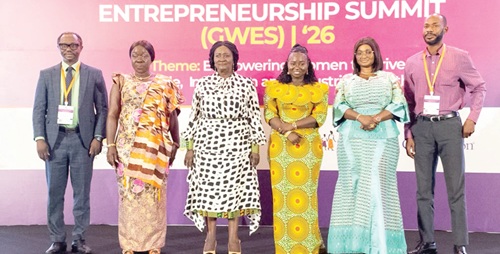
The Vice-President, Professor Naana Jane Opoku-Agyemang, has announced that a committee established to oversee the creation of the Women’s Development Bank has completed its work and submitted a banking licence application to the Bank of Ghana through the Ministry of Finance for regulatory consideration.
She said the committee brought together market women, susu collectors, representatives of women’s business associations and financial sector professionals to ensure the bank reflects the needs and aspirations of women.
“I consider their involvement essential because their work should be informed by their experiences and designed to reflect the financial realities of their businesses.
“The work is conceived as a frontline institution that will bring financial services within reach of women who have long found professional banking difficult to access,” she said.
She said the purpose of the bank “is not merely to gain credit, but also to provide financial services that will support and reach so many of our women who conduct businesses”.
“The plan will not overcome women's faith, but will address women’s access to a solid financial system for their needs,” Prof. Opoku-Agyemang added.
She was speaking at the Ghana Women Entrepreneurship Summit (GWES) 2026 in Accra yesterday on the theme: “Empowering women to drive trade and industrial growth.”
A Youth Enterprise launchpad was also launched at the event, which was supported by Mastercard Foundation, MTN, Camfed, and Compassion.
A citation was presented to the Vice-President for the Women’s Bank initiative.
Prof. Opoku-Agyemang called for improved access to affordable financing for women entrepreneurs.
She said the country could not fully unlock its economic potential if women-led businesses continued to face barriers to growth.
The Vice-President highlighted the significant contribution women make to the country’s business landscape, adding that they accounted for approximately eight out of every 10 businesses operating in the informal sector.
She, however, observed that women remained underrepresented among large businesses, controlling only about 10 per cent of such enterprises.
“Many are very willing and disciplined to expand their businesses. They know their customers, understand their costs, and have broad plans; however, securing finance on reasonable terms remains a serious challenge for women.
“We have to make it possible for more women to take the business they have built as far as their ambition and ability can take them,” the Vice-President said.
Capability
The Minister of Trade, Agribusiness and Industry, Elizabeth Ofosu-Adjare said that women possessed the ingenuity, resilience and entrepreneurial capacity required to establish competitive domestic enterprises, expand into international markets and create sustainable employment.
She underscored the importance of equipping women with the knowledge and skills required to navigate financial systems, understand business requirements and take advantage of available support programmes.
The minister called for stronger investment in training, quality standards and market readiness to enable women-led enterprises to participate more effectively in domestic, regional and international trade.
Mrs Ofosu-Adjare also encouraged women entrepreneurs to take advantage of available platforms to exchange ideas, share experiences, receive feedback and build relationships necessary for business expansion.
The Chief Executive Officer of Ghana Enterprises Agency, Margaret Ansei, said they were building relationships with potential buyers and partners abroad to ensure women who were doing well in business at home had a fair opportunity to compete on the international market.
