
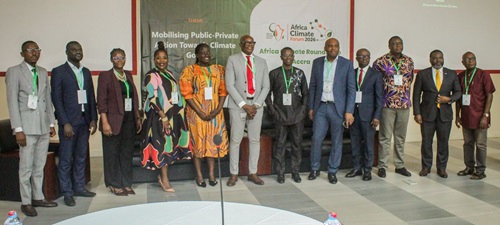
Panellists at a round table on climate actions in Africa have called for policy certainty, stronger institutional capacity and the development of bankable climate projects to help unlock climate financing across Africa.
That, they said, was because regulatory inconsistencies, weak project preparation systems and limited technical capacity continued to discourage investors and delay access to climate funds across the continent.
The roundtable held in Accra yesterday was organised by the Global Centre for Law, Business and Economy as a precursor to the Africa Climate Forum (ACF) 2026 to be held in Nigeria.
It was on the theme: “Mobilising Public-Private Action Towards Climate Goals” and brought together private and public climate stakeholders and players to have interactions that will be a ladder to new, effective partnerships that result in inclusive and investable project pipelines.
Predictable policies, capacity building
The General Manager of Jospong Green Transition Office, Dr Glenn Gyimah, said regulatory inconsistencies, weak institutional capacity and difficulties in accessing climate funds continued to discourage private sector participation in climate action.
He stressed the need for predictable policies, robust monitoring systems and simplified funding procedures to help businesses develop bankable climate projects and attract investors.
The Principal Economic Officer at the Ministry of Finance, Eunice Inkoom, said the country had established several institutional and legal frameworks, including the PPP law and procurement systems to support climate-related investments.
Creating synergies
The Head, Risk and Sustainability Management at the Ghana Infrastructure Investment Fund, Kwadwo K. Gyan, said Africa was gradually progressing towards stronger climate partnerships but remained constrained by fragmented systems and limited coordination.
He called for strategic alliances capable of mobilising private sector investments, strengthening local decision-making capacity and encouraging greater collaboration across African countries and institutions.
The Executive Director of Tangelic, Jesston Williams, said many climate partnerships in Africa remained fragmented and transactional despite shared climate goals.
He explained that governments, donors, private sector actors and communities often pursued different priorities, making implementation difficult and called for more coherent and inclusive partnerships capable of delivering sustainable long-term climate outcomes.
Unlocking finance
The Convener of the Africa Climate Round Table, Professor George Nwangwu, said Africa’s climate transition required stronger cross-border and cross-sector partnerships because climate change was a borderless challenge that no single institution or country could solve alone.
He enumerated the importance of just transition, climate finance, policy, technology and accountability partnerships in driving low-carbon growth, while stressing that fragmented capacities, regulatory gaps and infrastructure deficits continued to hinder progress.
The Chief Executive Officer (CEO) of TSL Sustainability and Country Partner to the forum, Dr Shelter Lotsu, described the Africa Climate Round Table as a strategic platform for mobilising partnerships, investment and innovation to support Africa’s climate-resilient future.
He said the continent’s climate agenda should be viewed not only as an environmental challenge but also as an opportunity for economic transformation, green industrialisation and sustainable infrastructure development.
