
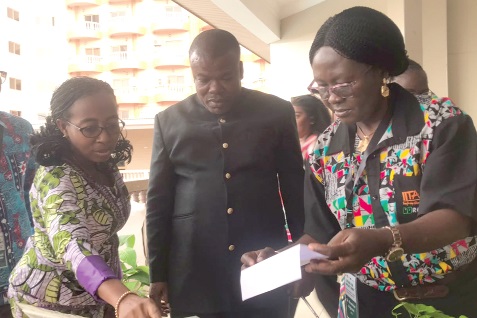
Speakers at a National Yam Advocacy Summit have called for increased investment in the country’s yam seed system to ensure access to quality planting materials to increase productivity and strengthen exports.
They said Ghana was the world’s second-largest producer of yam and the leading exporter but it continued to face major constraints, such as limited availability of quality seed, high seed costs, low multiplication rates and inconsistent seed quality.
However, they said a leaf-bud cutting technology developed by the International Institute of Tropical Agriculture (IITA) was increasing the availability of quality planting materials which the country had adopted.
Unlike the traditional method, which relied on tubers and had low multiplication rates and often poor-quality seeds, the new technology is simple, efficient and produce high-quality seed yams.
The speakers were the Deputy Director-General of the Council for Scientific and Industrial Research (CSIR), Professor Marian Quain; the Minister of Food and Agriculture (MoFA), Eric Opoku; Country Director of IITA, Dr Richard Asare; Emeritus Director of the IITA, Dr Robert Asiedu; PROSSIVA Coordinator at IITA, Dr Delphine Amah; and the Seed Systems Specialist at IITA, Dr Beatrice Aighewi.
The summit was organised by MoFA in collaboration with IITA through the Programme for Seed System Innovation for Vegetatively-propagated crops in Africa (PROSSIVA) in Accra last Thursday.
It was aimed at providing a platform for stakeholders to promote wider adoption of improved seed yam technologies across the country.
It was on the theme: “Transforming Ghana’s yam sector through seed system innovation.”
Innovation
Mr Opoku said the country produced more than 11 million metric tonnes annually from over 600,000 hectares cultivated, adding that yam exports were valued at approximately US$48 million in 2022.
“Ghana has every reason to be proud of its yam sector. We are the second-largest producer of yam in the world and the number one exporter globally,” he said.
He, however, stressed that sustaining such a position would depend on stronger collaboration among stakeholders to accelerate the commercialisation of quality seed yam production.
Seed yam systems
Dr Asare said IITA had worked closely with national research institutions, particularly the CSIR-Crops Research Institute and the Savanna Agricultural Research Institute (SARI), to develop improved seed yam systems tailored to the country’s needs.
He said strengthening the country’s seed yam system would, among others, improve farmer incomes, enhance food and nutrition security, create jobs and strengthen agribusinesses.
Dr Amah said PROSSIVA was a five-year project being implemented from 2025 to 2027, aimed at scaling up research innovations to address longstanding bottlenecks in the yam seed system.
She said certified seed yam could produce yields more than 90 per cent higher than farmer-saved seed, while reducing disease risks and increasing farmers’ incomes.
She added that small certified mini tubers weighing between 30 and 100 grams had consistently outperformed larger farmer-saved tubers weighing 200 to 500 grams.
Dr Aighewi also stated that the country’s seed system presented enormous business opportunities, particularly for private seed companies capable of supplying farmers with improved yam varieties.
Climate-smart
Prof. Quain said the innovations were climate-smart because seed production could be undertaken throughout the year under appropriate conditions and stored for planting during the main farming season.
Dr Asiedu said expanding the adoption of quality seed technologies would require active participation from seed companies, farmer groups and agricultural extension officers.
