
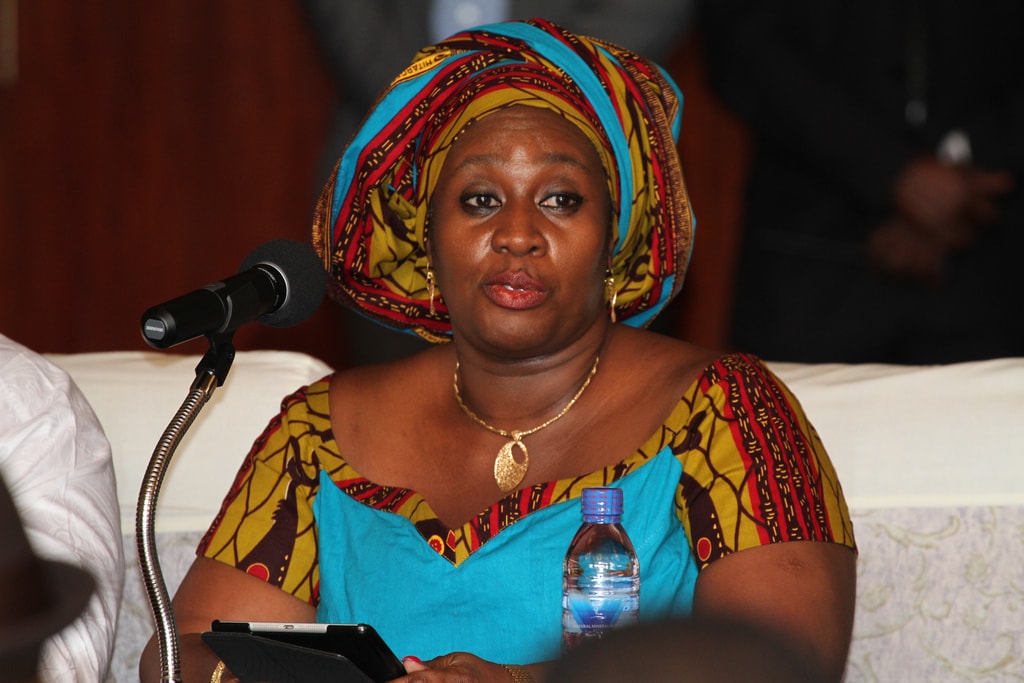
The Interior Minister, Muntaka Mohammed-Mubarak, has dismissed growing speculation that the convicted former Microfinance and Small Loans Centre (MASLOC) Chief Executive Officer, Sedina Christine Tamakloe Attionu, is being held outside the state prison system, insisting that she is securely in custody and serving her 10-year sentence.
"She's serving her term, trust us; she is serving her term," the minister said in an interview last Wednesday, June 25, 2026, amid suspicion from opposition Members of Parliament about her exact location.
However, Daily Graphic investigations have uncovered that prior to her admission into a state prison facility, Ms Attionu passed through two separate security installations, the cells of the Bureau of National Intelligece (BNI) for initial debriefing and documentation, and the custody unit of the Police Hospital for medical evaluation and treatment, before being formally committed to serve her sentence.
Security sources, who spoke on condition of anonymity due to the sensitive nature of the matter, confirmed these movements, stressing that the stopovers were standard procedure for high-profile extradited convicts, and as such did not amount to preferential treatment.
Security concerns
Mr Mohammed-Mubarak pushed back against demands by opposition MPs for disclosure of the precise facility where the former MASLOC boss is being held, citing security considerations.
"Maybe in Ghana, we take telling people where somebody is serving lightly, because in America and other countries, telling people that this kind of high-profile person is here can even lead to the death of that person. So it's for safety," he said.
"Was she not sentenced? She was. If she were sentenced, where would she be? You must be in prison custody," he added, stating further that anyone seeking to verify her whereabouts or arrange a visit could do so through the established procedures of the Ghana Prisons Service.
US custody
Sources familiar with the extradition process disclosed that Tamakloe Attionu was held at a detention facility in the state of Nevada from January 2026 until her transfer to Ghana, meaning she had spent approximately six months in United States custody before her arrival at the Accra International Airport on June 9, 2026, aboard United Airlines flight UA 996 from Washington Dulles International Airport.
Officials of the Ghana Police Service and the Ghana Prisons Service received her upon arrival.
Appeal
Her lawyers have filed a comprehensive written submission before the Court of Appeal, Criminal Division, Accra, urging the appellate court to set aside her conviction and acquit her on all charges.
The defence argues that the prosecution failed to prove its case beyond reasonable doubt, and that the charge sheet on which she was convicted was fundamentally defective, violating Article 19(2)(d) of the 1992 Constitution.
The defence argues that the particulars of offence in most counts merely repeated the statutory definition of the offence without specifying the actual acts or omissions allegedly committed by the appellant.
The submission cites a line of the Supreme Court and Court of Appeal decisions, including Ernest Thompson & 5 Others, Criminal Appeal No. J3/05/2020 and Osei v The Republic (No. 2) (1971) GLR 449, which established that defective particulars of offence are fatal to a conviction and cannot be cured by evidence.
On the substantive charges of stealing, the defence argues that the prosecution called only seven witnesses, none of whom were beneficiaries of the sensitisation programmes allegedly not carried out, nor regional officers of MASLOC from the affected areas.
The submission contends that the failure to call these material witnesses was fatal to the prosecution's case.
On the vehicle procurement charges, the defence points to cross-examination evidence establishing that not a single cedi had been paid by MASLOC at the time the appellant left office in January 2017, that the contract price was subsequently renegotiated by the incoming management, and that payments were only made in 2018, well after her departure.
On the ex gratia payments, evidence from the prosecution's own witness — the Head of Finance of MASLOC — confirmed during cross-examination that the payments were processed by his office based on proper documentation from the Office of the President and the Human Resource department, and that he personally found nothing untoward in the documents before authorising payment.
The appeal is Case No. CR 904/2017 before the Court of Appeal, Criminal Division, Accra.
Background
Ms Tamakloe Attionu, who served as MASLOC CEO from November 2013 to January 2017, was arraigned before the High Court Financial Division on January 30, 2019, on 78 counts spanning conspiracy to steal, stealing, causing financial loss to the State, causing loss to public property, improper payment of public funds, unauthorised commitment resulting in financial obligation to government, money laundering and breach of the Public Procurement Act.
She was convicted in absentia by Justice Afia Serwah Asare-Botwe on April 16, 2024, having been granted permission by the High Court to travel abroad for medical treatment but failing to return, leading to the continuation of proceedings in her absence.
The government submitted a formal extradition request to the United States in July 2024, with the current Attorney-General following up to expedite the process in 2025.
Her co-accused, Daniel Axim, a former Chief Operations Officer of MASLOC, was granted bail and remains on bail pending his own appeal.
