
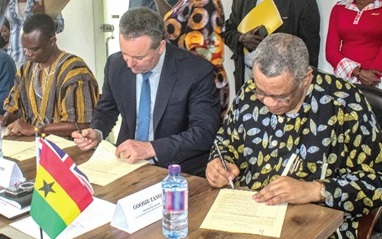
The 24-Hour Economy Authority has signed a $270-million integrated poultry investment agreement with four developing partners under the National Poultry Transformation Programme to grow the industry, create jobs and cut down poultry product imports.
The partners are Agrium Capital from the United Kingdom, Petra Pension Trust, Axis Pension Trust and Ghana EXIM Bank.
The agreement covers irrigated feed-cropping and a feed mill, through parent-stock breeder farms and a hatchery, to broiler grow-out and a modern processing plant, with cold chain, logistics and market access built in as one system rather than assembled piece by piece.
The investment is to create 12,000 direct jobs and targets 20,000 tonnes of dressed and processed broiler products a year, scaling towards 50,000 tonnes at full build-out.
The mixed-capital partnership brings foreign direct investment led by Agrium Capital together with Ghanaian partners – Petra Pension Trust, Axis Pension Trust and Ghana EXIM Bank.
Phase One
The first phase of the project is to create 15,000 acres of maize and15,000 acres of soya to feed 15 million birds.
The Presidential Advisor on the 24-Hour Economy, Augustus Goosie Tanoh, who signed on behalf of the secretariat in Accra last Thursday, said despite significant reforms, valuable partnerships and decades of national effort, Ghana's economy remained structurally deformed.
"Much of our growth still depends on the export of raw materials and the import of both finished goods and the intermediate input needed to keep our industries running.
"Just a few of our young people can access decent, dignified work. Too many of our industries operate well below their productive potential," he said.
Mr Tanoh said Ghana had every endowment to run at full capacity, currently ceded to producers in Brazil, the United States and Europe.
"Ghanaians eat roughly 340,000 tonnes of chicken a year. Self-sufficiency has fallen from close to 80 per cent a generation ago to about 12 per cent today.
"The rest, some 270,000 tonnes, arrives frozen and costs Ghana close to US$400 million in foreign exchange every year," he said.
"The project is to create income that belongs to Ghanaian farmers, feed millers, processors and haulage drivers, who are paid instead of someone else's economy far from our shores," Mr Tanoh added.
The Presidential Advisor said the terms would be fully developed into a shareholders’ agreement for execution by the parties in the coming weeks.
Mr Tanoh said reducing Ghana's poultry import bill was not a mystery.
Reduce overreliance on importation
The Chief Executive Officer (CEO) of Agrium Capital Limited, Rod Bassett, who signed on behalf of the rest of the partners, said for the past 70 years, the company had established a successful track record in developing and managing large-scale, specialist industrial and commercial businesses and investments across multiple sectors, globally.
He noted that the poultry sector in Ghana had been plagued by several challenges along the value chain, including limited access to quality inputs, scale and quality feed production, limited access to genetics and lack of efficient production and processing practices; hence, competitiveness with imports was constrained.
Mr Bassett said the huge reliance on imports to meet the growing demand was unsustainable.
He expressed excitement at the new partnership with the hope that the project would reduce Ghana's overreliance on importation.
The CEO said to transform agriculture into a productive, sustainable and high-value sector in Africa, an estimated $200 billion in annual investment was needed to close development gaps, raise productivity and meet increasing demand.
