
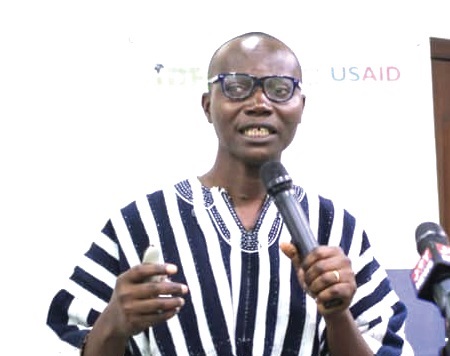
A local governance expert, Douglas Quartey, has called for a rethink of making district assembly elections non-partisan.
That, he explained, was because Ghanaians still had a strong appetite for partisan elections despite the challenges with the excesses of political parties and electioneering.
Forum
He made the call at a Citizens Forum organised by the Institute for Democratic Governance (IDEG) and Oxfam in Accra on Wednesday (August, 26, 2026).
It was on the theme, “Constitutional Reform and Democratic Decentralisation in Ghana: The Way forward for Local Governance”.
The forum comes on the heels of a position paper of the government by the Attorney General and Minister of Justice, Dominic Ayine, on July 30, 2026, after a Constitutional Review Commission Report (CRC) of December 2011 and a Constitutional Review Committee Report of December 2025.
Mr Quartey shared these thoughts when he presented a paper on the “Constitutional Reforms and Democratic Decentralisation in Ghana: The Way Forward”.
Government position
He said the government’s position on the Committee’s report of December 2025 of electing Metropolitan, Municipal and District Chief Executive (MMDCEs), retaining a non-partisan local government and continuing to appoint a third of Assembly members was untenable and had to be looked at again.
He explained that evidence from research, Afro Barometer studies, as well as presidential and parliamentary election data showed that Ghanaians turned out in their numbers when elections were held at the national level on partisan lines.
From the 2025 Afro Barometer Report (Round 10) most of the people surveyed wanted elections to choose their leaders, while they also disagreed with the government appointing local authorities.
Mr Quartey said political parties with economic clout mounted bill boards, organised campaigns and social programmes, and generally got community members automatically engaged in the process, hence the large turnout at national elections.
He noted that political parties were often deeply involved in the outcomes of local elections.
Additionally, from 1998 to date, comparatively analysing district assembly election results and general election results showed that Ghanaians turned out more during elections.
Implication
Mr Quartey said an implication of the government’s position on the December 2025 Committee’s report was that accountability of local government leaders, something Ghanaians yearned for, would not be realised with those appointed being accountable only to the appointee.
Additionally, independent candidates would not have the opportunity to contest in MMDCE elections, while “citizens choice as the sovereign in a democratic system of governance would be lost”.
Opening the meeting, the executive assistant to the Executive Director of IDEG, Maame Konadu Aboagyee, and Oxfam’s Interim Head of Programmes/Head Accountable Governance Programme, Mahmoud Mohammed, both stressed the importance of the forum and the need for citizens to continue with discussions and conversations on the topic for the best options for implementation.
E-mail:
