
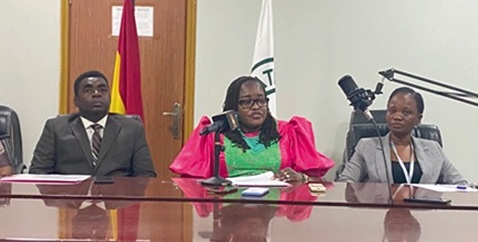
The National Labour Commission (NLC) has launched digital platforms to enable employers, employees and other stakeholders to access the commission’s information and services without necessarily visiting its offices.
The platforms — Instagram, X (formerly Twitter), Facebook, YouTube and WhatsApp — have been introduced to improve public education, stakeholder engagement and access to information on labour-related matters.
Through the WhatsApp platform, complaints can be lodged by sending a “Hi” or “Hello” to 020-661-2837, after which a link to download the complaint form is sent to the user. The completed form can then be submitted on WhatsApp.
The Executive Secretary of the NLC, Dr Bernice Welbeck, said the initiative had been introduced to strengthen communication, deepen stakeholder engagement and enhance public access to the Commission’s services.
Services accessible
The Executive Secretary of the NLC said the commission’s mandate to promote harmonious industrial relations through the settlement of labour disputes made effective communication and public education important.
She said the commission’s work through adjudication, mediation, arbitration and other alternative dispute resolution mechanisms contributed to industrial peace.
“Today marks another significant milestone in our journey to strengthen communication, to deepen stakeholder engagement and enhance public access to the vital services we provide,” she said.
Dr Welbeck said stable labour relations promoted productivity, attracted investment, protected workers’ rights and created an enabling environment for businesses to thrive.
She said the commission’s responsibility therefore extended beyond dispute resolution to educating the public, building trust among stakeholders and fostering a culture of dialogue and mutual respect.
Dr Welbeck said the increasing reliance on digital platforms for credible, timely and accessible information had made it necessary for the NLC to establish an active presence on social media.
She added that the platforms would ensure that accurate information reached employers, employees, trade unions, employer organisations, the media, students, researchers and the general public.
Public education
Dr Welbeck said the platforms would serve as interactive channels for stakeholders to seek clarification, provide feedback and participate in discussions on labour relations.
Effective communication, she said, was a two-way process and that the commission was committed to listening as much as it communicated.
Dr Welbeck also said the social media presence would support continuous public education on the rights and responsibilities of employers and employees.
She added that an informed workforce and informed employers were better positioned to prevent disputes before they arose.
“An informed workforce and informed employers are better positioned to prevent disputes before they arise, so we want to be proactive more than reactive,” she said.
Institutional records
Dr Welbeck said the initiative would also support the preservation of the commission’s institutional records through digital content.
She gave an assurance that information shared on the platforms would be guided by accuracy, timeliness, professionalism, integrity, transparency, accountability and respect, stressing that the launch marked the beginning of a new chapter in the commission’s engagement with the public.
“The launch of our social media platforms is not an end in itself; rather, it marks the beginning of a new chapter in our engagement with the public,” she said.
