
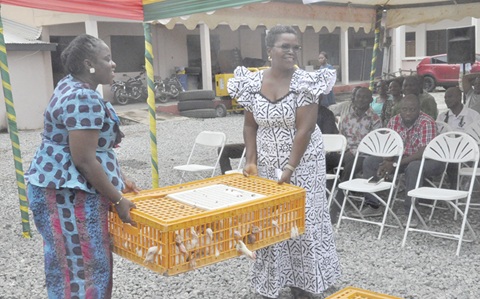
The ’Nkoko Nkitinkiti’ project in the Volta Region, under the Feed Ghana Programme, has been launched in Ho.
Fifty individuals and groups received cages of chickens for their poultry farms
The nationwide distribution of poultry birds to various beneficiaries is expected to reduce poultry imports by 10-15 per cent in the initial phase, saving the country between USD30-60million annually, said the National Coordinator of the Feed Ghana Programme, Bright Demordzi, as he launched the project.
He said it would definitely ensure the creation of direct and indirect jobs ranging from feed milling, hatcheries, veterinary services, transport, processing, and marketing.
The project would also improve protein availability and food security, particularly for low-income and middle-income households, Mr Demordzi maintained.
In the medium term, he said, sustained scaling of the project was projected to cut Ghana’s poultry import bill by more than 50 per cent, while repositioning the country toward self-sufficiency in poultry meat and eggs.
“So, Ghana can no longer afford to import what it has the capacity to produce,” Mr Demordzi insisted.
He explained that the ‘Nkuko Nkitinkiti’ project was not just a mere poultry venture but an economic recovery tool, a job programme, and food security intervention.
In that regard, Mr Demordzi gave an assurance that the government remained fully committed to sustaining that momentum, scaling production, and working with all stakeholders to rebuild a resilient, competitive, and self-reliant poultry industry for Ghana.
The Volta Regional Minister, James Gunu, said the project was an appropriate and timely intervention to reduce poverty.
He said it also bore ample testimony to how President John Dramani Mahama delivered his promises to the people.
It, therefore, signified hope and great expectation for the people, Mr Gunu said.
Ho MCE
The Ho Municipal Chief Executive (MCE), Stephen Adom said for the municipality in particular, the initiative represented enormous opportunities for youth employment, women empowerment, agribusiness expansion, poverty reduction, and improved household incomes.
He entreated the beneficiaries to embrace the intervention not only as a means of consumption but as a path towards economic independence and community development.
Present at the ceremony were the various municipal and district chief executives in the region.
