
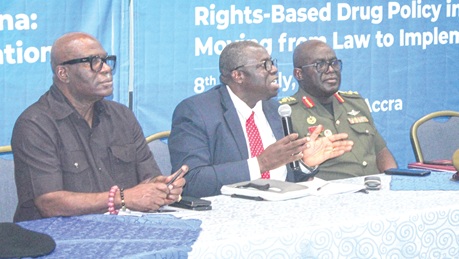
Stakeholders in justice, health and drug control sectors have begun a two-day national dialogue to identify implementation gaps in the Narcotics Control Commission Act 2020 (1019), which seeks to strengthen public health, protect human rights and improve coordination among implementing institutions.
The second National Dialogue on Drug Policy, Human Rights and Health, which opened in Accra yesterday, was on the theme: "Advancing a People-Centred, Rights-Based Drug Policy in Ghana: Moving from Law to Implementation".
Organised by the Narcotics Control Commission (NACOC) in collaboration with the International Drug Policy Consortium (IDPC), WAPCAS Plus, the United Nations Development Programme (UNDP), the Joint United Nations Programme on HIV/AIDS (UNAIDS) and international and national partners, it is expected to develop practical recommendations to guide the implementation of the law and its accompanying Legislative Instrument (LI).
Commitment to action
At the opening ceremony, the Deputy Minister for the Interior, Ebenezer Terlabi, said the time had come to move from commitment to action by ensuring that the law translated into practical interventions that protected public health, respected human rights and strengthened law enforcement.
He said the country had reached a stage where attention must shift from policy formulation to implementation.
He explained that although Act 1019 recognised substance use as both a criminal justice and public health issue, many people with substance use disorders continued to face arrest, stigma and limited access to health services.
He said the fear of arrest and discrimination discouraged many from seeking treatment.
"When individuals do not feel safe in accessing health services, then we must acknowledge that something in our system is not working as it should," he said.
The Deputy Interior Minister said one of the biggest obstacles to implementing the law was the absence of the legislative instrument required to operationalise many of its provisions, adding that while law enforcement must remain firm against organised criminal networks engaged in drug trafficking, individuals struggling with substance use disorders required treatment and rehabilitation rather than punishment.
"Many are themselves vulnerable. Many require support, not punishment. The question is not whether we enforce the law, but how we enforce it," he said.
Legislation to implementation
The Director-General of NACOC, Major General Maxwell Obuba Mantey, said the country had made significant progress since the first national dialogue, particularly with the enactment of Act 1019, which sought to balance law enforcement with prevention, treatment, rehabilitation and social reintegration.
He, however, said the priority had shifted from legislation to implementation.
Major General Mantey said discussions would focus on reducing stigma, strengthening collaboration between the justice and health sectors, addressing emerging threats such as synthetic drugs and identifying practical measures to advance harm reduction.
He expressed concern about increasing drug use among young people, particularly schoolchildren.
He urged Ghanaians to take personal responsibility for drug prevention by educating people within their communities about the dangers of substance abuse.
Human rights
The Chairman for the opening session, Justice of the Supreme Court, Justice Sir Dennis Dominic Adjei, said the country's drug laws must be implemented in a manner that respects fundamental human rights while maintaining strong action against traffickers and organised criminal networks.
He said that although Act 1019 had introduced alternatives to custodial sentences for people convicted of possessing small quantities of drugs, implementation gaps remained.
Justice Adjei argued that imprisoning people suffering from substance use disorders often worsens their circumstances rather than addressing the underlying problem.
"If you imprison somebody for smoking, the person goes to prison hardened and is likely to repeat the offence when released," he said.
He said the country’s obligations under international human rights instruments, including the African Charter on Human and Peoples' Rights and other international conventions, required authorities to ensure that drug policies protected dignity, promoted access to health care and reduced discrimination.
