
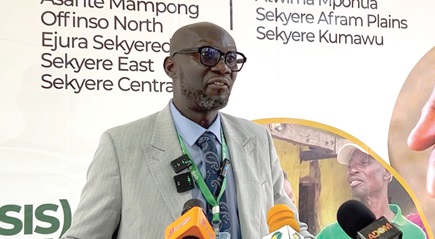
The Ashanti Regional Director of Health Services, Dr Fred Adomako-Boateng, has advised recipients of drugs administered for river blindness and bilharzia to report severe or unusual reactions for immediate assessment and management.
He said mild side effects such as dizziness, headache, itching, abdominal discomfort, or nausea might occur in some individuals as a result of the drugs, but explained that “these effects are usually temporary and an indication that the medicine is working against the parasites.”
Dr Adomako-Boateng, who was speaking during a media briefing last Monday as part of activities to create awareness on the ongoing mass drug administration in the Ashanti Region, therefore, stressed that “Any person experiencing severe or unusual reactions should immediately report to the nearest health facility for assessment and management.”
Background
The two diseases, onchocerciasis (river blindness) and schistosomiasis (bilharzia), which are part of Neglected Tropical Diseases (NTDs), continue to affect residents in communities, especially those living near rivers, streams, and water bodies.
Nationally, the transmission of onchocerciasis has been interrupted in 64 of the country's 149 endemic districts, while the burden of onchocerciasis, schistosomiasis, lymphatic filariasis, and soil-transmitted helminthiasis has been reduced by more than 90 per cent.
To further interrupt disease transmission and advance efforts towards elimination, the World Health Organisation (WHO) recommends achieving and sustaining therapeutic coverage of at least 80 per cent of the eligible population in all endemic communities.
The campaign is taking place in nine selected districts, including Ahafo Ano North, Asante Mampong, Atwima Mponua, Offinso North, Ejura Sekyedumase, Sekyere East, Sekyere Central, Sekyere Kumawu and Sekyere Afram Plains, between June 20 and July 3, 2026.
Drug administration
The mass drug administration programme in the Ashanti Region has consistently recorded commendable performance, as therapeutic coverage in the targeted onchocerciasis districts has generally ranged between 80 and 87 per cent over the past two years.
In September 2025, for example, the Sekyere East District achieved 86.6 per cent coverage, while Atwima Mponua, Offinso North, Sekyere Central, and Sekyere Kumawu recorded coverage above 82 per cent.
Dr Adomako-Boateng said the achievements demonstrated the commitment of communities and health workers.
He expressed appreciation to other partners such as traditional authorities, community volunteers, and health workers for their unwavering support in the fight against NTDs.
He further urged eligible residents in beneficiary districts to welcome health workers and community drug distributors to their homes, listen to their advice, and take the medicines.
By so doing, he said, “ You will be protecting yourself, your family, and your community from diseases that have caused suffering for far too long.”
“Together, we can eliminate onchocerciasis and schistosomiasis from the Ashanti Region and secure a healthier future for our children and generations yet unborn. Let us all support the campaign and ensure that every eligible person is reached,” Dr Adomako-Boateng advised.
Writer’s email:
