
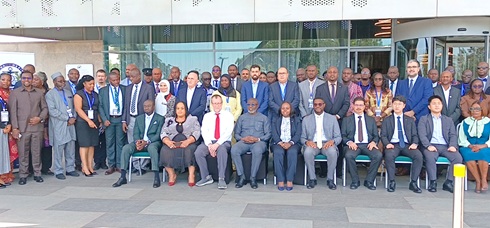
The Director-General of the Ghana Maritime Authority (GMA), Naval Captain (retd) Dr Kamal-Deen Ali, has called for closer coordination among maritime agencies in West and Central Africa to integrate existing digital systems and to improve port efficiency and facilitate trade.
He said institutional disputes over ownership and control of information systems must be addressed to reduce delays and ensure agencies work towards a common goal of trade facilitation.
Dr Ali made the call last Monday at the opening of a three-day sub-regional workshop on the Maritime Single Window (MSW) and Port Community System (PCS).
The workshop was supported by the Government of Ghana, the Africa Transport Policy Programme, the World Bank Group, the Korea-World Bank Partnership Facility and the International Maritime Organisation (IMO)
It brought together representatives from nine member states to share experiences, assess existing systems and develop approaches to maritime digitalisation in West and Central Africa.
Maritime Single Window
Dr Ali said Ghana had digital systems supporting port operations, vessel clearance and maritime safety, but their effectiveness could be improved through better integration and coordination.
He cited the Integrated Customs Management System, vessel traffic clearance systems operated by the Ghana Ports and Harbours Authority (GPHA) and the GMA’s vessel traffic monitoring system as existing infrastructure that could be strengthened.
He said the link between maritime trade and safety made efficient information exchange among relevant institutions essential.
The workshop, he said, would allow participants to examine their systems, share experiences and develop a roadmap towards a more cohesive Maritime Single Window (MSW).
He acknowledged that institutional ownership and control of digital platforms could pose challenges but stressed that agencies had a shared responsibility to facilitate trade.
The MSW enables ships and shipping companies to submit information required by public authorities for vessel arrival, stay and departure through a single digital platform, reducing paperwork and duplication.
The PCS supports broader information exchange among public and private stakeholders involved in port operations, cargo handling and logistics.
Collaboration
The World Bank Group’s Senior Trade Facilitation Specialist, Satya Sahu, said digitalising individual port processes without connecting systems could force businesses to submit the same information repeatedly to different agencies.
He said effective digital transformation required institutions to collaborate and ensure their systems could exchange information securely.
The Minister of Transport, Joseph Bukari Nikpe, whose remarks were read by the Ministry’s Director of Research, Statistics and Information Management, Merlyn Gaskin, said efficient port operations were vital to Ghana’s economic growth and international trade.
He described the ports of Tema and Takoradi as strategic national assets that connected businesses to international markets, generated employment and supported livelihoods.
The minister called for stronger institutional cooperation, adequate technical and financial support, and a clear implementation roadmap to maximise the benefits of maritime digitalisation.
The Head of the Africa Section of the International Maritime Organisation (IMO), Mwanaulu Issa Mwajita, said successful implementation required clear institutional responsibilities, simplified procedures, sustainable financing, sound data governance and cybersecurity.
She said the IMO Compendium on Facilitation and Electronic Business provided a foundation for consistent data exchange and interoperability among maritime systems.
