

Bono East has the waterfalls, the wildlife, the forests and the history that tourists look for.
What it has not yet fully built is the economy around them.
Across the region, attractions such as Kintampo Waterfalls, Boabeng-Fiema Monkey Sanctuary, Digya National Park, Bono Manso, Tanoboase Sacred Grove and Buoyem caves draw visitors or hold the potential to do so.
Yet in many communities that host and protect these treasures, tourism remains more of a promise than a dependable source of jobs and income.
That creates a striking paradox: a region rich in tourism assets but still struggling to turn those assets into lasting economic opportunities for the people who live around them.
The question facing Bono East, therefore, is no longer whether it has tourism attractions.
It is whether the region can turn those attractions into an economy that rewards the communities protecting them.
Cost of conservation
At Boabeng-Fiema, a farming community in the Nkoranza North District, the relationship between tourism, conservation and livelihoods is particularly complex.
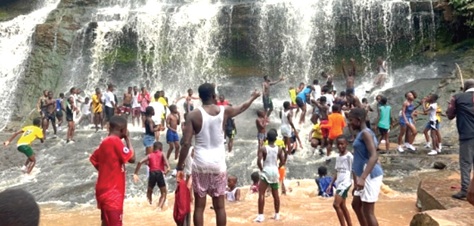
Some tourists at the Kintampo Waterfalls
The community is home to Mona and Black-and-White Colobus monkeys, which have traditionally been regarded as sacred and protected by residents.
The sanctuary recorded 21,856 visitors in 2025, including 20,704 Ghanaians and 1,152 non-Ghanaians.
But the monkeys also create challenges for farmers.
A farmer in the community, Gyau Martin, said the animals sometimes entered farms and destroyed crops, leaving farmers to bear the losses.
“Although the monkeys are revered and protected, the persistent damage to our crops remains a major challenge, leaving farmers like me to bear the cost of conservation with little or no compensation at all,” he said.
His experience raises a broader question about community-based tourism: if communities are expected to protect wildlife because it is a tourism asset, what mechanisms ensure that they also benefit from the value created by that protection?
A tourism model that counts visitors but pays little attention to the people living around attractions risks leaving communities with responsibility without sufficient reward.
Kintampo Waterfalls remains the most visible symbol of Bono East's tourism potential.
About four kilometres from Kintampo along the Kintampo-Tamale highway, the waterfall is formed by the Pumpum River, a tributary of the Black Volta.
The water cascades about 70 metres over three stages, while a canopy walkway provides an additional attraction.
Investment at the facility has demonstrated what is possible.
World Bank-supported improvements have included paving the three entry points, planting trees and giving the wider enclave a facelift.
The Ghana Statistical Service also recorded Kintampo Waterfalls among the leading destinations for domestic same-day visitors in 2025.
But the bigger tourism story lies beyond Kintampo.
Tourism sites
At Buoyem, caves shelter a large colony of fruit bats within a sacred grove. Bono Manso has historic sites associated with the slave trade, while a nearby waterfall adds a natural attraction to the landscape.
Tanoboase Sacred Grove combines history, culture and nature.
There is also the Amoowi Hole and Cave at Pinihini, the Kunsu Slave Market, Digya National Park and the Volta Lake around Yeji.
The Geographical Centre of Ghana, Fuller Falls, Dandwa Waterfalls, Forikrom Boten Shrine and Cave and the Africa-Shaped Rock at Buoyem further expand the region's tourism offering.
Having many attractions, however, does not automatically create a tourism economy.
A visitor who comes to a waterfall and leaves immediately creates far less economic activity than one who stays overnight, eats locally prepared food, hires a guide, buys a locally made product and visits other attractions.
That is where Bono East's tourism challenge becomes a development issue.
Without reliable roads, water, electricity, sanitation, accommodation, visitor facilities and effective promotion, there is limited incentive for businesses to invest around attractions.
Young people who could work as tour guides, conservation workers or hospitality staff may see little opportunity in the sector.
Farmers who could supply food to hotels and restaurants may remain disconnected from the tourism value chain, while artisans and small businesses may miss opportunities to sell directly to visitors.
Waiting to generate value
The region's historical attractions present another missed opportunity.
Bono Manso is connected to the history of the Trans-Atlantic Slave Trade, when enslaved people from northern parts of present-day Ghana were brought to the area, sorted and prepared for onward movement towards the coast.
The Bono Manso and Kunsu Slave Markets, therefore, have the potential to provide powerful historical and educational experiences.
But heritage tourism requires interpretation.
Visitors need information, trained guides, preserved sites, signage and facilities that help them understand what happened there.
Without such investment, important history risks remaining physically present but economically and educationally underused.
The same applies to sacred groves, caves and traditional sites whose value extends beyond physical beauty to the stories, beliefs and traditions they preserve.
Unlocking this potential requires more than developing individual attractions.
It requires a system that connects tourism to the local economy through better roads and basic infrastructure, visitor facilities, sanitation, accommodation, trained guides and stronger promotion.
Communities must also have meaningful roles in tourism development.
Residents should be able to benefit through employment, guiding, accommodation, catering, transport, crafts and agriculture.
Such links would create an important connection between conservation and economic benefit.
When communities see tourism as a source of income, protecting attractions becomes not only a cultural responsibility but also an economic interest.
Durimg the recent visit by the Minister of Tourism, Culture and Creative Arts, Abla Dzifa Gomashie, she commended traditional authorities, local officials and residents for preserving the environment and warned against encroachment.
She described Bono East as a “perfect destination for adventure and relaxation.”
But recognition alone will not unlock the potential.
Investment
Bono East does not lack tourism assets.
What it needs is the development, connection and investment required to turn those assets into a stronger regional tourism economy.
Its waterfalls continue to flow, its monkeys continue to roam, its forests continue to shelter wildlife, and its historic sites continue to preserve memories of the past.
The challenge is to move from having tourism attractions to building a tourism economy, one that protects these treasures while ensuring that the communities that host them share meaningfully in their value.
Writer's email:
