
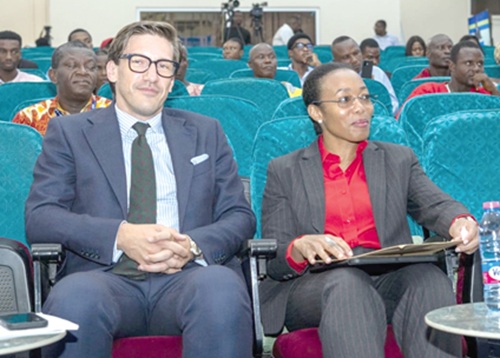
The Minister of Environment, Science and Technology, Dr Zanetor Agyeman-Rawlings, has called for climate risk to be integrated into national security and district development plans to prevent conflicts, displacement and violent extremism.
She identified competition over land and water, unpredictable rainfall and loss of livelihoods as factors worsening tensions in vulnerable communities and creating opportunities for extremist groups to exploit local grievances.
Dr Agyeman-Rawlings made the call at this year’s Climate Talks at the Kofi Annan International Peacekeeping Training Centre (KAIPTC) in Accra, yesterday, on the theme: “Building climate-security resilience in Ghana.”
The event brought together government officials, security agencies, traditional leaders, academics, civil society organisations, researchers, development partners and local communities who examined the link between climate change and security.
She cited farmer-herder conflicts and competition over water resources as examples of how environmental pressures could deepen existing disputes and increase demands on security agencies.
Priority actions
Dr Agyeman-Rawlings outlined five priority areas for addressing climate-related security risks. They are: integrating climate security into development planning, linking early-warning systems to timely action, ensuring fair access to natural resources, strengthening trust between communities and security institutions, and creating green jobs for young people.
She also proposed that climate-security assessments be included in district development plans, with early warnings reaching District Security Councils, the National Disaster Management Organisation (NADMO) and traditional authorities.
Measures such as designated grazing reserves, livestock corridors and community water points were also needed to reduce competition over scarce resources.
The minister further called for the establishment of regional climate-security platforms to bring together traditional leaders, local authorities and security agencies to identify potential disputes and address them before they escalated.
Climate action
Dr Agyeman-Rawlings further said that Ghana’s updated Nationally Determined Contribution, known as NDC 3.0, was undergoing final approval before submission to the United Nations Framework Convention on Climate Change (UNFCCC).
The plan focuses on areas that include renewable energy, sustainable transport, nature-based solutions, climate-resilient infrastructure and adaptation.
She called for increased adaptation finance, adding that recommendations from the climate talks would help inform policy and the implementation of the nation’s climate commitments.
Discussions
The German Ambassador to Ghana, Frederik Landshoeft, said climate talks had taken place in Tamale, Bolgatanga, Kumasi and Keta before the final event in Accra.
The discussions involved communities and stakeholders, security institutions, traditional leaders, researchers and civil society groups, who examined how climate pressures affected farming, migration, natural resources and community security.
In Tamale, discussions highlighted the effects of changing rainfall patterns and longer dry seasons on agriculture and livelihoods.
In Bolgatanga, participants examined migration, competition over resources and the challenges facing communities along Ghana’s northern borders.
And in Kumasi, discussions touched on the effects of illegal mining on water bodies and the difficulties faced by emergency services, while in Keta, coastal erosion and saltwater intrusion were identified as threats to homes, coconut trees and farming.
Mr Landshoeft observed that climate change did not automatically cause conflicts but could intensify existing tensions, particularly where resources and economic opportunities were limited.
He called for the discussions to translate into practical measures in climate adaptation, disaster risk reduction, natural resource management and conflict prevention.
Germany, he added, would continue to support Ghana’s efforts through cooperation and technical assistance; however, Ghanaian institutions and communities must lead the response.
