
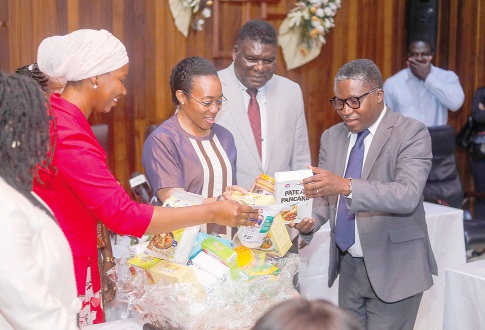
The Minister of Environment, Science and Technology, Dr Zanetor Agyeman-Rawlings, has stressed the need for stronger collaboration between the government, scientific institutions and industry to translate research into commercial products, while tackling emerging environmental challenges.
She also asked the various institutes under CSIR to provide research findings and information that could be presented in a manner that was easily understood by the public.
The minister said the country needed to make better use of research and innovation generated locally while putting in place systems to manage new forms of waste arising from the increasing adoption of electric vehicles, solar panels and other green technologies.
Dr Agyeman-Rawlings was speaking during familiarisation visits to the Council for Scientific and Industrial Research (CSIR), and the Electrical and Electronic Waste Management Fund (E-Waste) Secretariat in Accra.
At CSIR, she focused on the need to make research and innovations more visible to the public and the private sector, improve the retention of scientists and strengthen the commercialisation of research outputs.
And at the E-waste Secretariat, the minister tasked the institution to develop strategies to anticipate and manage waste from emerging technologies.
Bridging research, industry
Dr Agyeman-Rawlings said her outfit would use its communication platforms to showcase the work of agencies under it.
She requested samples of products developed by CSIR, including agricultural and food products, for display at the ministry’s reception to give visitors a direct view of the institution’s work.
The minister further said that the country had the opportunity to use the African Continental Free Trade Area to expand the market for locally developed knowledge and technologies across the continent.
Dr Agyeman-Rawlings also called for stronger collaboration among government agencies and ministries to develop practical solutions to challenges such as land degradation, water pollution and environmental remediation.
She said research should move beyond publication to produce technologies and products that could be adopted by industry, generate economic value and safeguard the environment.
On staff retention, the minister said the recurring challenges surrounding staff retention and conditions of service needed to be addressed.
Tackling emerging e-waste
At the E-Waste Secretariat, Dr Agyeman-Rawlings said the increasing use of electric vehicles, solar panels and other renewable technologies would create new waste streams that the country needed to prepare for.
She tasked the secretariat to develop a strategy to deal with waste generated at the end of the lifespan of such technologies.
The minister said the country needed to either develop the capacity to recycle such materials locally or establish arrangements with countries that had the necessary facilities to process them.
She called for more effective waste segregation at the domestic, institutional and industrial levels to prevent hazardous materials from ending up in landfills.
Collaborate
The Director-General of CSIR, Professor Paul P. Bosu, said CSIR had developed expertise in areas including agriculture, natural resources, environment, industry, energy, food and nutrition and biotechnology over nearly seven decades.
Professor Bosu said the institution would continue to support the government with scientific evidence, technology development, entrepreneurship and commercialisation.
The Chairperson of the CSIR Governing Council, Mark Taylor, also called for support to improve research infrastructure, logistics and career pathways to help retain scientific talent.
