
The Executive Board of the International Monetary Fund (IMF) has approved the last review of Ghana’s progress and performance under the Extended Credit Facility (ECF).
The approval officially brings to an end Ghana's 36-month ECF bailout programme, which began in May 2023 following the 2022 economic crisis.
Consequently, the executive board’s approval which triggers the release of $360 million to the Bank of Ghana, bringing total disbursements under the IMF programme to $3 billion in support of reforms, stability and improvement in domestic revenue performance.
It has also approved the country’s request for a 36-month non-financing Policy Coordination Instrument (PCI) tabled two months ago.
The IMF conducted the sixth and final review of the ECF in May, this year, under Article IV consultation, during which Ghana requested for a non-financing PCI.
As macroeconomic stability takes hold, IMF’s final tranche will focus on consolidation, with emphasis on helping to sustain reform momentum and build resilience beyond the current ECF programme.
The staff-level agreement reached in May this year will sustain growth-friendly fiscal adjustment; safeguard debt sustainability; strengthen fiscal transparency and governance, particularly for state-owned enterprises, and enhance the monetary and exchange-rate policy framework.
It would also reinforce financial sector stability and support economic diversification and inclusive growth.
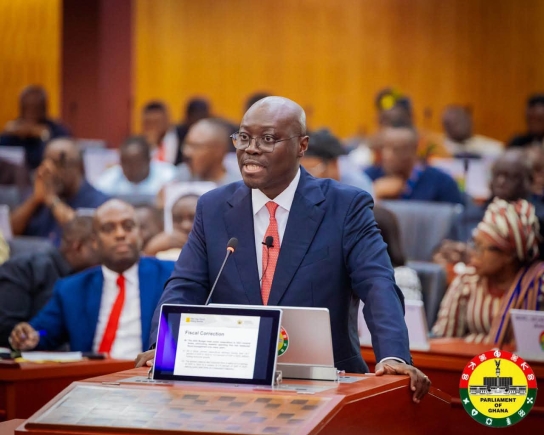
Last Thursday, the Minister of Finance, Dr Cassiel Ato Forson, presented the full tenets of the 36-month PCI arrangement with the IMF to Parliament as part of the statement on the Mid-year Fiscal Policy Review of the 2026 Budget and Economic Policy of the government.
With the ECF programme now complete, Ghana will begin a new phase of engagement with the IMF through the non-financing PCI.
Dr Forson said the non-financing PCI would support the government's reform agenda and help to sustain the gains achieved under the ECF programme.
“The government expresses its sincere appreciation to the people of Ghana for their resilience, patience, and unwavering support throughout the reform programme,” Dr Forson told the Daily Graphic moments after the IMF Executive Board approval yesterday.
On behalf of the government, Dr Forson also thanked the IMF Executive Board, IMF management and staff, development partners, civil society, and the private sector for their continued partnership and support.
“Government remains committed to protecting the gains achieved so far and implementing its reform agenda to build a stronger, more resilient, and more prosperous economy for all Ghanaians,” he added.
ECF
The ECF-supported programme has delivered substantial stabilisation gains.
The government has maintained fiscal discipline, reduced inflation, strengthened external buffers and implemented key reforms that have laid the foundation for sustained economic growth.
Fiscal performance has strengthened markedly, with the primary surplus overperforming the programme target in 2025, while the public debt ratio has declined sharply to 45 per cent of Gross Domestic Product (GDP), from over 85 per cent in 2022.
Growth exceeded expectations in 2025, supported by broad-based activity, and the external position strengthened on the back of historically high gold export receipts.
“The programme’s performance has remained broadly satisfactory, with quantitative targets mostly met, while structural reforms were implemented with delays.
Going forward, sustaining the reform momentum is critical,” the IMF Mission said in May this year.
Way forward
The IMF team which conducted the sixth and final review, however, cautioned against the uncertain global environment, saying while direct spillovers from the war in the Middle East had so far been limited, the impact of the war is expected to be transmitted through higher energy, food, and fertiliser prices.
The volatile external environment underscores the importance of preserving prudent policies and strengthening resilience.
While the mission acknowledged improvements in the debt trajectory which had created fiscal space, it expected its utilisation to address pressing development needs, promote youth employment, and strengthen social spending.
“Maintaining a forward-looking, prudent monetary policy is instrumental to firmly anchoring inflation expectations,” the IMF said in May.
It also called for efforts to ensure effective monetary policy transmission and confidence by strengthening the central bank’s balance sheet.
“The losses associated with the Domestic Gold Purchase Programme (DGPP) underscore the importance of increasing transparency and limiting quasi-fiscal activities that weaken the central bank’s balance sheet,” it said, adding that would help to enhance accountability and oversight.
The IMF also urged reinforcing financial sector stability, having welcomed recent progress in strengthening banks’ recapitalisation, unwinding temporary regulatory forbearance introduced during the debt exchange, and intensifying supervision and corrective actions for weaker institutions.
The Fund maintained that going forward, continued vigilance is essential to address the remaining vulnerabilities, including through effectively implementing reform and restructuring strategies for state-owned banks and specialised deposit-taking institutions, reducing high non-performing loans (NPLs), and supporting sustainable credit growth.
Protecting public resources through continued reform efforts in the energy and cocoa sectors was also essential.
While commending the government and the people, the IMF staff team said avoiding past policy slippages — including recurring cycles of fiscal imbalances, rising debt, weak buffers, and reform reversals — will be critical to safeguarding the hard-earned success.
