
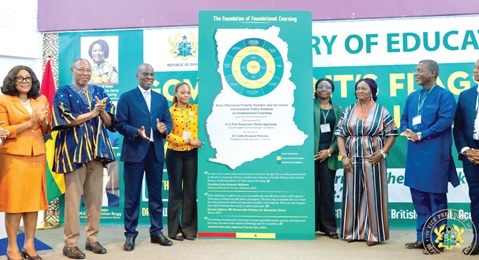
The Vice-President, Professor Naana Jane Opoku-Agyemang, has launched the government’s flagship Foundational Learning Agenda (2026-2040), a framework that will ensure that every Ghanaian child acquires the essential skills needed to learn successfully, especially at the early stages of education.
Speaking at the launch in Accra yesterday, Prof. Opoku-Agyemang explained that the agenda would ensure that by 2030, children aged four to eight in public and low-fee private schools would demonstrate significantly improved, age-appropriate proficiency in literacy, numeracy and psychosocial development.
She said the agenda sought to build on earlier efforts with some proposals on curriculum revisions that gave Ghanaian colleges a stronger role in early literacy instruction.
She disclosed that, subject to Cabinet's approval, the programme would be piloted before its wider implementation.
The Vice-President said the target would provide a clear benchmark against which progress could be assessed.
Background
The launch was on the theme: “Foundational Learning: Bedrock of Ghana’s Sustainable Future".
It was attended by students, teachers and public service staff, among others.
Investment
Prof. Opoku-Agyemang said that although successive governments had invested in expanding educational opportunities, developing teachers and improving infrastructure, learning outcomes remained uneven, with many children still struggling to acquire basic literacy and numeracy skills.
“A fundamental truth is that our education system cannot succeed if our children cannot think, write or count confidently.
The evidence continues to show that too many of our learners lack these essential skills,” she said.
Prof. Opoku-Agyemang, herself an educationist of repute, called for renewed efforts to improve foundational learning, stressing that the country’s education system must prioritise children’s ability to read, write, think and perform basic mathematical operations, for instance.
“We want an economy that produces more of what it consumes, processes more of its agricultural output, develops competitive industries, and creates better employment opportunities.
This requires investment in infrastructure, technology and enterprise. It also requires people who can learn, reason, adapt and apply knowledge in practical ways,” she added.
She said the years ahead presented an opportunity to make steady and measurable improvements in foundational learning.
Commendation
Prof. Opoku-Agyemang urged the Ministry of Education and sector stakeholders to ensure that the agenda built on what had worked, addressed shortcomings and avoided unnecessary duplication.
The Vice-President further called for close monitoring of results, identification of areas requiring additional support and necessary adjustments as implementation progressed.
She encouraged teachers, education authorities, parents and development partners to continue working together towards the shared goal of improving learning outcomes for Ghanaian children.
The Minister of Education, Haruna Iddrisu, said Ghana's literacy rate currently stood at approximately 78 per cent compared with a global figure of 98 per cent.
He added that about 91 per cent of the country's literacy rate was recorded among the population aged up to 15 years.
Mr Iddrisu said the figures showed that Ghana was making progress in literacy, although there were still challenges that needed attention.
He acknowledged that disparities existed in the provision of quality basic education between rural and urban communities, as well as between public and private schools.
He said the new strategy would seek to address these inequalities and improve access to quality foundational education for all children.
Mr Iddrisu assured Ghanaians that the government was committed to ensuring that no child was denied foundational basic education because of gender, geographical location or financial circumstances.
The minister also highlighted the importance of early childhood education, citing evidence that children who received quality early childhood education before the age of five performed better throughout their schooling than those who did not.
Commitment
The British High Commissioner to Ghana, Christian Rogg, reaffirmed the commission’s commitment to supporting Ghana’s education reforms, particularly the implementation of the Foundational Learning Agenda and efforts to improve teacher deployment across the country.
