
Ghana has urged Chinese investors in the country to move beyond the traditional export of raw minerals to a partnership in processing, technology transfer, skills development and industrialisation towards a deeper mining cooperation between the two economies.
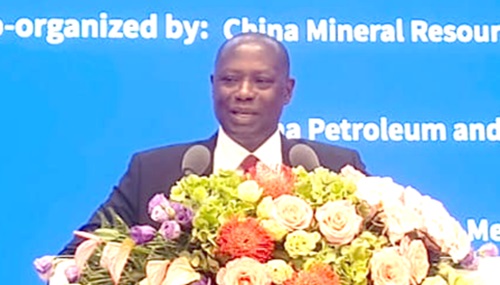
The Minister of Lands and Natural Resources, Emmanuel Armah-Kofi Buah, made the call when he addressed the Ministerial Forum on International Mining Cooperation and the opening of the 28th China Mining Conference and Exhibition 2026 in Tianjin, China.
Speaking on the theme: “Win-Win Cooperation, Green and Intelligent”, the minister said Ghana was ready to build a new generation of mining partnerships that would deliver greater value to the country, investors, mining communities and the wider global economy.
He said Ghana’s vision was no longer limited to extracting minerals and exporting them as raw materials, stressing that the country wanted its mineral wealth to drive industrialisation, create jobs and develop local expertise.
“The next chapter of mining must be measured not simply by what we take from the ground, but by what we leave above it: industries, skills, technology, restored land, stronger communities and a more prosperous nation,” he said.
Beyond exports
Mr Buah said while resource-rich countries, including Ghana, had supplied raw materials for decades, most processing, technology and value creation took place elsewhere.

Participants during the 28th China Mining Conference and Exhibition 2026 in Tianjin, China
He said Ghana was determined to change that model under President John Dramani Mahama’s leadership by ensuring that minerals contributed directly to value addition, industrial development, job creation and skills development.
The minister said Ghana was reviewing its mining regulatory framework, formalising artisanal and small-scale mining and strengthening transparency and responsible oversight across the gold value chain.
Investment targets
Mr Buah highlighted the presence of major Chinese companies, including Chifeng Gold Group, Shandong Gold and Zijin Mining, in Ghana’s mining sector, describing their investments as evidence of what the two countries could achieve through cooperation.
He said Ghana, however, wanted future partnerships to go beyond extraction.
“We want the next generation of partnerships to go further into processing, technology, skills development, infrastructure and local supply chains,” he said.
The minister also placed environmental sustainability at the centre of Ghana’s mining agenda, particularly in the fight against illegal and irresponsible mining.
He cited the establishment of the National Anti-Illegal Mining Operations Secretariat (NAIMOS) as part of the government’s efforts to strengthen the fight against illegal mining, while the Responsible Cooperative Mining and Skills Development Programme (rCOMSDEP) advanced as part of efforts to formalise small-scale mining.
Ghana-China partnership
Mr Buah described Ghana and China as longstanding partners whose relationship dated back more than six decades, noting that Ghana was among the early African countries to establish diplomatic relations with China under President Kwame Nkrumah.
He said the partnership had expanded from diplomacy into trade, education and infrastructure, with mining increasingly becoming an important area of cooperation.
Mr Buah, therefore, urged Chinese investors and international mining companies to see Ghana as a strategic destination for long-term investment.
