
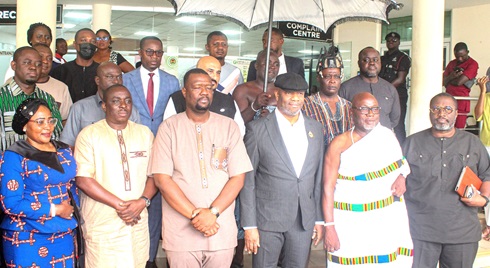
The Ga Mantse, King Tackie Teiko Tsuru II, has called for stronger partnership between the chieftaincy and corporate institutions to promote the country's development agenda.
He said enhanced collaboration between the two sides would create synergies, unlock investment opportunities and propel the government's development agenda.
Particularly, he said the government's agenda to create a 24-Hour Economy required that traditional authorities work closely with key state agencies to eliminate stumbling blocks.
The Ga Mantse made the call when he paid a courtesy call to the Driver and Vehicle Licensing Authority (DVLA) in Accra last Tuesday.
The courtesy call formed part of the traditional ruler's strategic visits to state institutions to learn firsthand their operations and areas of partnership.
The Ga Mantse explained that the overall objective of the series of visits to the corporate institutions was to bridge the gap between the two sides.
Commendation
The Ga Mantse commended the DVLA for introducing reforms to improve service delivery and make the authority accessible to members of the public.
“I am very impressed with what I have seen here today, and I want to encourage you to continue to bring reforms that will boost public confidence in the DVLA and make it a strategic state institution to propel development,” he said.
He added that in the era when the government was rolling out the 24-Hour Economy policy, the transport sector would play a key role, which was why the DVLA needed to be proactive in its service delivery.
Good move
For his part, the Chief Executive Officer of DVLA, Julius Neequaye Kotey, described the visit by the Ga Mantse as “a big motivation”, as it would encourage the authority to work more for quality service delivery.
“This royal visit tells us here at the DVLA that people are watching what we do here as a state institution, and we cannot lower the standards,” he said.
Mr Kotey said the call for effective partnerships between state institutions and traditional authorities was a step in the right direction, indicating that it was only through such collaborations that policies could be effectively implemented.
For instance, he said the expansion drive by the DVLA and the other reforms being explored required the support of chiefs.
Delinquency charges
Speaking to journalists during the visit, Mr Kotey reiterated that the DVLA was ready to defend its imposition of delinquency charges on motorists with expired driving licences in court.
He explained that those charges were approved by Parliament as part of the legal framework governing the authority’s operations.
“DVLA doesn’t determine our charges.
They are determined by Parliament. It is a law which was enacted in 2012 and amended in 2025, so we are ready to face them in court,” he said.
Mr Kotey’s comment was in response to the call by public policy think tank CUTS International that Parliament should investigate the legality and administration of the charges.
He stressed that the call by CUTS International for the DVLA to suspend the delinquency charges pending disclosure of their legal basis, approval process and calculation formula was not justifiable.
Mr Kotey explained that the DVLA’s new automated enterprise software (IPP Pro system) automatically applied the approved charges when a driving licence expired, leaving staff with no discretion to remove or alter the fees.
He added that the automated system was introduced to prevent inconsistencies in the application of charges and eliminated opportunities for staff to negotiate payments with motorists.
The DVLA CEO said the new system had ensured accountability in the management of resources, explaining that before the introduction of the new system, some DVLA staff were able to remove delinquency charges and negotiate alternative payments with motorists.
