
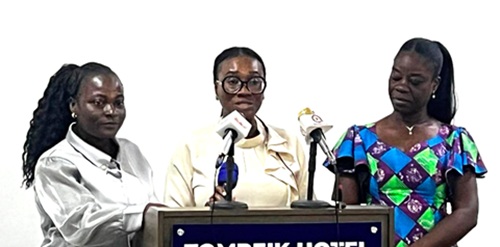
The International Federation of Women Lawyers (FIDA-Ghana) has called on the government to use the 2027 national budget to significantly increase allocation to the Domestic Violence (DV) Support Fund and the DV Secretariat and to prioritise the construction of shelters for survivors across the country.
The call comes as the country prepares to mark the 20th anniversary of the passage of the Domestic Violence Act, 2007 (Act 732).
Passed on February 22, 2007, after over 18 years of advocacy, and assented to on May 3, 2007, the legislation aims to eliminate domestic violence, protect the human rights of women and children, and shift domestic violence from a private family matter to a public legal issue.
FIDA Ghana made the call at a press conference it organised in Accra last Wednesday ahead of the expected November 12, 2026.
The Act established the DV Support Fund to provide basic material support, training, rescue, rehabilitation and reintegration of victims, construction of reception shelters in regions and districts, and training and capacity building for persons connected with the provision of shelters.
It also established the DV Secretariat to lead the administration and operational mandate.
DV Fund
According to FIDA-Ghana, however, since 2017 both the Secretariat and the fund had faced structural, financial and operational challenges that limited their effectiveness in protecting survivors.
The Federation identified low budget allocation as a major challenge.
It said the DV Fund was plagued by chronic underfunding, extreme annual volatility and delays. Because the Ministry of Gender, Children and Social Protection (MoGCSP) allocates up to 94.7 per cent of its budget to larger initiatives such as LEAP and the School Feeding Programme, the DV Fund receives less than 0.01 per cent of the ministry's total budget.
Also, it said the fund had recorded zero capital expenditure.
Consistently, no funds have been earmarked for building or expanding shelters.
The only shelter in Accra was a donation, which has since been rehabilitated solely by donor support.
These challenges, FIDA-Ghana said, were having devastating impacts.
The most immediate is the near-total lack of state-run emergency shelters across Ghana.
Because allocation contains virtually no capital expenditure, the Secretariat relies almost entirely on limited privately-run non-governmental organisation (NGO) spaces.
Without a haven, survivors are frequently forced to remain in or return to abusive environments.
Inadequate funding has also left state agencies anaemic, with the DV Secretariat, DOVVSU and social welfare offices experiencing shortages in vehicles and functional office equipment.
Furthermore, by law, the fund is meant to cover free medical examinations and legal care, but is only able to support fewer than 30 survivors nationally in some years.
Survivors must pay GH¢500 to GH¢2,000 for mandatory medical examinations and thousands more for psychological assessments or filing protection orders.
The Federation said the inability to cover basic costs such as transportation for expert witnesses and investigators made it difficult to secure convictions, pricing the poorest victims out of justice and healthcare systems and creating an environment of legal impunity that discouraged reporting and weakened cases.
