
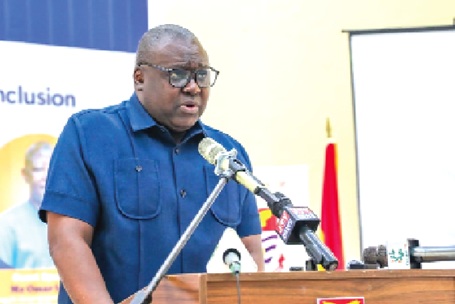
The Bank of Ghana (BoG), the National Development Planning Commission (NDPC), the Ghana Statistical Service (GSS) and academia have jointly called for a stronger national shift towards data-driven decision-making, describing data as the foundation of modern governance and economic transformation.
The call was made during the Data Literacy Week 2026, held at the University of Cape Coast (UCC).
It was organised by the Department of Data Science and Economic Policy (DSEP) under the School of Economics (SoE) on the theme, “Building a Data-Smart Ghana: Evidence, Ethics and Inclusion.”
At the centre of the discussions was a strong message that data has become the most critical asset for national development, with speakers warning that policies, economic planning and public accountability cannot succeed without reliable and timely information.
Speaking during the event, the Director of Research of the BoG, Dr Philip Abradu-Otoo, described data as the “new gold” and the invisible force behind all major monetary policy decisions.
He explained that every key decision of the central bank, from inflation analysis to interest rate adjustments and financial stability assessments, was anchored on verified data rather than opinion, stressing that without data, central banking would lose credibility and effectiveness.
Dr Abradu-Otoo stated that inflation figures, exchange rate movements and reserve levels were not just statistics, but powerful indicators that shaped policy decisions affecting farmers, businesses and households across the country.
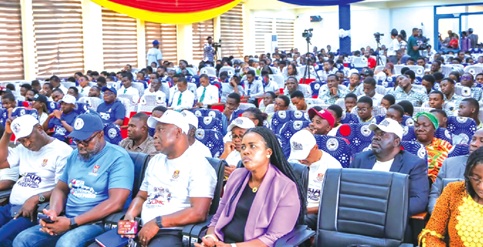
Participants
He urged students and young professionals to cultivate a strong appetite for quality data, describing data literacy as an essential skill for understanding the economy in the era of artificial intelligence and digital transformation.
The Director-General of the NDPC, Dr Audrey Smock Amoah, reinforced the need to recognise data as a national resource generated daily through systems such as birth registration, education records, National Health Insurance Scheme (NHIS) claims, mobile money transactions and census data.
She warned that while data could drive efficiency, fairness and innovation, it could also deepen inequality and mistrust if it was not handled ethically and inclusively.
Dr Smock Amoah emphasised that a “data-smart Ghana” should be built on core principles such as evidence, ethics and inclusion, stressing that national planning should be grounded in facts, guided by integrity and designed to ensure that no group is left behind.
She further cautioned against over-reliance on aggregated statistics because such approaches often hid inequalities affecting rural communities, informal workers and vulnerable populations.
Representing the Government Statistician, David Maxwell Bessah of the GSS, highlighted official statistics as the backbone of national planning and a key safeguard against misinformation.
He explained that the country’s statistical systems, including the 2021 Population and Housing Census and ongoing national surveys, provided the foundation for policy design, budgeting and development monitoring.
Mr Bessah stressed that statistical literacy was essential not only for experts, but for all citizens, adding that data only became powerful when it was understood, trusted and properly used.
He added that the GSS was intensifying efforts to simplify data communication and expand public engagement to ensure that statistics were accessible and meaningful to all segments of society.
The acting Vice-Chancellor of the UCC, Professor Denis Worlanyo Aheto, expressed appreciation to all stakeholders, particularly the BoG, for sponsoring the programme, describing data literacy as a critical life skill in today’s digital economy.
He stated that the initiative extended beyond the university, targeting traders, artisans, transport operators and senior high school students as part of efforts to build an inclusive data-literate society.
Prof. Aheto further revealed that the university had trained facilitators and students through its data literacy programme to serve as mentors, promoting evidence-based thinking and innovation across communities.
