
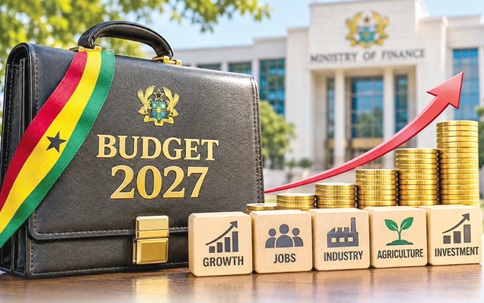
The government will buy back locally issued bonds in February next year; the Minister of Finance, Dr Cassiel Ato Forson, is expected to announce this in today’s Budget Statement and Economic Policy of the government.
He said funds for all the GH¢29 billion of the principal bonds, which would fall due in February next year, had been set aside in a Sinking Fund to buy back the bonds.
The associated interests (coupons), amounting to GH¢11 billion, would then be retired by January 2028.
The Minister of Finance announced this in Accra yesterday when he interacted with selected journalists ahead of the presentation of the 2027 Budget Statement to Parliament today.
He said those expenditures were the two biggest facing the economy next year, and that buying them back would bring back confidence in the economy.
Dr Forson explained that aside from restoring confidence in government treasury management, buying back the bonds would also anchor the country’s debt to the value of its total productivity (Gross Domestic Product) at the sustainable 45 per cent threshold.
New Economy
He said the budget would spend a great deal of time to spell out the New Economy in detail.
He explained that the $10 billion expenditure earmarked for the next four years would be financed from the savings being made from tax and revenue measures such as the customs regime overhaul and closing loopholes in the Ghana Free Zones regime.
Dr Forson recalled that the budget recorded a primary surplus — the difference between a government's total revenue and its total non-interest expenditure — of 2.5 per cent in 2025, and this year the budget was on course to record a 1.5 per cent primary surplus.
He said next year, the surplus was expected to be scaled down to 0.5 per cent for the medium term so that the one per cent revenue savings, estimated at GH¢30 billion, would be channelled into the New Economy.
Dr Forson explained further that the New Economy would change the structure of the economy, as well as the revenue generation and utilisation architecture.
The changes to be announced in the 2027 budget would include amendments to the Income Tax Act and the Revenue Administration Act, while a new Loans Act would be promulgated to close loopholes and engineer far-reaching reforms and impacts.
“Under the new Loans Act, we will not borrow to finance consumption such as the buying of flight tickets, facilitate workshops and procure vehicles. Borrowing will be strictly meant to deliver social infrastructure, utilities and capital expenses,” he said.
The budget will also outline plans to merge the Ghana Infrastructure Investment Fund (GIIF) and the Mineral Income Investment Fund (MIIF) into a Ghana Sovereign Wealth Fund to execute big-ticket infrastructural projects and invest in industrial projects.
This reform will also come along with a new enactment, the Natural Resource Revenue Management Act, which would direct all resources from the extractive sector into the Sovereign Wealth Fund.
“If you take the petroleum revenue we have been receiving, the only thing we can point to is the Atuabo Gas Processing Plant.
The Accra-Kumasi Expressway project has taught us a lot of lessons, and so we are no more going to spread such revenue so thin; we will direct them into monumental projects for visible results and impact,” the Finance Minister stressed.
Dr Forson said the budget would also announce two major incentives under the 24-Hour Economy.
They are the Accelerated Depreciation and the Deferred Tax regimes, which would be explained in detail this evening.
Also, the Ghana Sovereign Wealth Fund would become equity partners in some of the 24-Hour Economy projects to give confidence to investors to take advantage of the policy, which has been designed to be private sector-led.
The budget would also provide a boost for agriculture. It would uncap the Ghana Import-Export Bank (Ghana EXIM) Bank to make available more resources, estimated at GH¢600 million, available to the development bank.
However, it would be required to channel at least 40 per cent into agriculture, particularly into poultry production, to enable the country to achieve self-sufficiency in that sub-sector.
Today’s budget will also announce long-term measures to recapitalise the Bank of Ghana.
Dr Forson said the country was hit by at least four major shocks, but due to the fiscal buffers and discipline, those shocks did not distort the economy the way they could have.
He also credited the impact of the Ghana Gold Board’s foreign exchange intervention, as well as the local refinery of crude oil, which made products available at all times to absorb the shocks.
The Finance Minister paid glowing tribute to the President, John Dramani Mahama, who had been involved in the decisions and had given him his tacit support to implement the measures.
