
The country will require about $500 billion to transition to a net-zero economy by 2070, the Technical Advisor to the Minister of Energy and Green Transition, Seth Mahu, has said.
He said the government could not shoulder the cost alone and, therefore, called on civil society, financial institutions and the private sector to join hands in financing the shift.
A net-zero economy is an economic system where the total greenhouse gases added to the atmosphere are balanced by an equal amount removed.
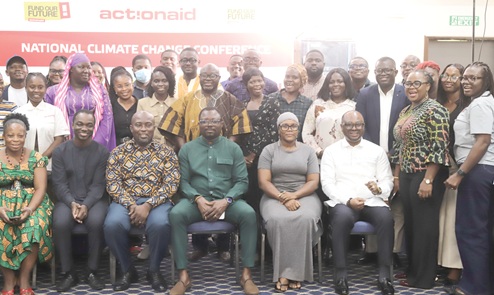
Mr Mahu was speaking at a national climate change conference on the theme: "Transitioning to a just and sustainable renewable energy in Ghana: Government and civil society perspectives."
It was organised by ActionAid Ghana, in Accra, last Tuesday.
The event brought together government officials, civil society, academia, the private sector, development partners and community representatives.
Renewable targets
Mr Mahu outlined a five-decade roadmap targeting 10 per cent renewable installed capacity by 2030, rising to 26 per cent by 2040, when nuclear energy was expected to enter the mix.
By 2070, renewables would make up 20 per cent of a projected 21,000-megawatt installed capacity, with thermal and nuclear energy accounting for the rest.
The nation currently has 342.5 megawatts of installed renewable capacity, about six per cent of the national generation mix.
He cited a solar street lighting programme, under which 30,000 of a targeted 125,000 lights had been procured, covering 1,000 kilometres of road and saving 8.2 million kilowatt-hours annually — a figure projected to hit 34 gigawatt-hours at full scale.
Mr Mahu said the transition must also cover agriculture, water and transport, including equity.
CSOs perspective
Speaking from a civil society perspective, Dr Charles Ofori of the Africa Centre for Energy Policy (ACEP) said the transition must be treated as an economy-wide development agenda rather than one ministry, since it touches on finance, trade, industry, gender and energy.
He said Ghana should build on existing strengths, such as cabling and aluminium production for solar mounting structures and explore recycling to recover materials from solar panels, and to create jobs across the clean energy value chain.
For his part, the Country Director of ActionAid Ghana, John Nkaw, said the word "just" was central to the transition conversation, determining who has a voice, who benefits and who bears the cost.
He said the government must not fund transition through unsustainable debt and urged attention to affordability and fiscal space.
Mr Nkaw explained that the dialogue was meant to examine real policy choices, not merely advocate renewables and expressed hope it would yield clear recommendations to strengthen national policy and advocacy.
