
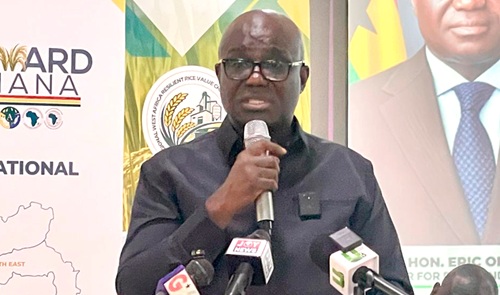
An $18.8 million initiative has been launched to boost domestic rice production and reduce the country’s dependence on imports, with a target of achieving self-sufficiency in rice by 2028.
Dubbed "Regional West Africa Resilient Rice Value Chains Development Project (REWARD)", the five-year initiative is expected to benefit 20,000 smallholder farmers through improved seeds, modern agricultural machinery and investments in rice processing infrastructure.
The project will be rolled out in seven districts across four regions.
The beneficiary areas are the Tamale metropolis, Savelugu municipality and Mion district, all in the Northern Region; Mamprugu-Moagduri district in the North East Region; West Gonja district in the Savannah Region, and the Wa municipality and Nandom district, both in the Upper West Region.
The project is being implemented by the Ministry of Food and Agriculture (MoFA), with grant support from the African Development Bank (AfDB).
Support
Launching the project in Tamale last Monday, the Minister of Food and Agriculture, Eric Opoku, said about 20,000 smallholder farmers, including women and young people, would benefit directly.
He said 3,200 hectares of land would be developed in the Northern Savannah Ecological Zone to support rice production, while selected seed centres and processing facilities would receive equipment.
The machinery to be supplied includes rotary tillers, seed drills, rice transplanters, boom sprayers and mini crawler combine harvesters.
Mr Opoku urged beneficiaries to ensure the proper use and maintenance of the equipment, adding that operators would require adequate training and transparent access arrangements.
The minister said the country currently produced about 56 per cent of its rice requirements, with the remaining 44 per cent imported at an estimated cost of $500 million annually.
He said domestic milled rice production had increased from 685,000 tonnes in 2022 to 960,000 tonnes in 2025.
Scaling up
Mr Opoku said the country needed to scale up production to achieve its 2028 self-sufficiency target, with a national paddy rice production target of 3.31 million tonnes.
“Our ambition is to progressively reduce this import dependence by expanding domestic production, improving productivity, strengthening processing capacity and ensuring that locally produced rice can compete favourably in quality, availability and price,” he said.
The minister described REWARD as a critical component of the government's Feed Ghana Programme, which seeks to strengthen domestic food production.
Mr Opoku added that selected processing facilities would receive colour sorters, destoners and improved parboiling vessels to improve the quality and competitiveness of locally produced rice.
The project would also strengthen links among farmers, processors, aggregators, distributors and institutional buyers to improve market access.
Addressing challenges
The Manager of the Agriculture and Agro-Industry Department at the AfDB, Dr Damian Ihedioha, also said that the would help address challenges in the rice sector, particularly low productivity, limited access to modern farming equipment and inadequate processing capacity.
He said the initiative would improve farmers' access to quality seeds, modern technologies and markets, while creating opportunities for women and young people.
For his part, the Northern Regional Minister, Ali Adolf John, lauded the initiative and said it would strengthen agriculture and create economic opportunities in the region.
He said an effective rice value chain would ensure that the benefits of increased production extended beyond farmers to processors, traders and other businesses.
