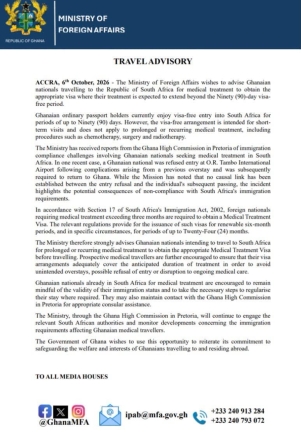
The Ministry of Foreign Affairs has advised Ghanaian nationals travelling to South Africa for medical treatment to obtain the appropriate visa where the treatment is expected to extend beyond the 90-day visa-free period.
In a travel advisory issued on October 6, 2026, the Ministry noted that Ghanaian ordinary passport holders currently enjoy visa-free entry into South Africa for periods of up to 90 days. However, it said the visa-free arrangement is intended for short-term visits and does not apply to prolonged or recurring medical treatment, including procedures such as chemotherapy, surgery and radiotherapy.
The Ministry said it had received reports from the Ghana High Commission in Pretoria of immigration compliance challenges involving Ghanaian nationals seeking medical treatment in South Africa. In one case, a Ghanaian national was refused entry at O.R. Tambo International Airport following complications arising from a previous overstay and was subsequently required to return to Ghana.
While the Mission noted that no causal link has been established between the entry refusal and the individual's subsequent passing, the incident highlights the potential consequences of non-compliance with South Africa's immigration requirements.
In accordance with Section 17 of South Africa's Immigration Act, 2002, foreign nationals requiring medical treatment exceeding three months are required to obtain a Medical Treatment Visa. The relevant regulations provide for the issuance of such visas for renewable six-month periods, and in specific circumstances, for periods of up to 24 months.
The Ministry therefore strongly advised Ghanaian nationals intending to travel to South Africa for prolonged or recurring medical treatment to obtain the appropriate Medical Treatment Visa before travelling. Prospective medical travellers were further encouraged to ensure that their visa arrangements adequately cover the anticipated duration of treatment in order to avoid unintended overstays, possible refusal of entry, or disruption to ongoing medical care.
Ghanaian nationals already in South Africa for medical treatment were encouraged to remain mindful of the validity of their immigration status and to take the necessary steps to regularise their stay where required. They may also maintain contact with the Ghana High Commission in Pretoria for appropriate consular assistance.
The Ministry said it will continue to engage the relevant South African authorities and monitor developments concerning the immigration requirements affecting Ghanaian medical travellers, and reiterated government's commitment to safeguarding the welfare and interests of Ghanaians travelling to and residing abroad.