
The Ada East District Assembly in the Greater Accra Region has admitted that the recurring tidal-wave devastation along the area’s coastline cannot be tackled with yearly emergency interventions with the assembly’s limited resources.
It said a permanent engineering solution was urgently required to protect vulnerable communities from the devastating sea erosion in three of the most affected communities - Azankpe, Kewunor and Ayigboe.
The assembly pointed out that the scale and cost of the problem were beyond its financial capacity and called for a broader, long-term intervention to address the menace.
Huge unsustainable cost
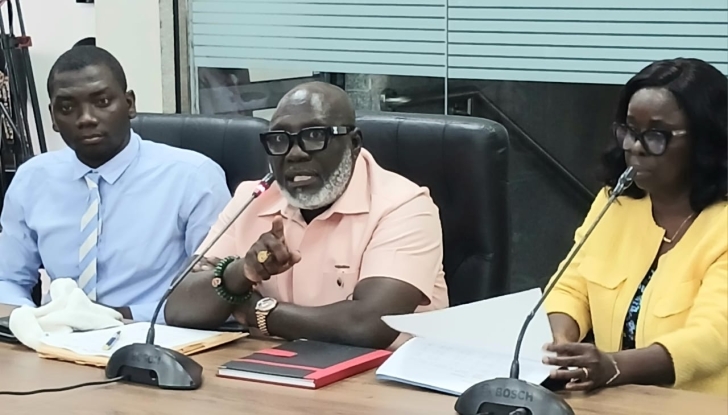
“We gave the dredging to a contractor but the amount involved is so huge but we are trying as much as possible to raise another funds this year to be able to do it,” the District Chief Executive (DCE) for Ada East District, Kenneth Kabu Kanor, said when he appeared before the Committee on Local Government and Decentralisation in Parliament Wednesday (Oct 7, 2026).
He was there to respond to questions on the district's development challenges and some financial infractions contained in the 2025 Auditor-General’s report on the assembly.
Scarce resources
The DCE identified Azankpe as the community currently bearing the brunt of the tidal-wave problem, with Kewunor and Ayigboe having received some relief through dredging under the assembly's internally generated funds.
He agreed with the committee that continuing to spend scarce assembly resources on temporary measures every year was not a sustainable solution.
When the Chairperson of the committee, Queenstar Pokua Sawyerr, asked whether he agreed that the tidal waves constituted one of the district's biggest challenges and should not be treated as a temporary problem, he responded: “You are 100 per cent right that it should not be temporary. It should be a permanent thing.”
Mr Kanor explained that the “financial burden required to curb tidal waves impact exceeded the strength of the assembly financially”.
Declined revenue
On revenue generation, Mr Kanor told the committee that the assembly’s internally generated funds had declined from GH¢2.9 million last year to about GH¢1.4 million as of September this year.
He said the assembly was taking steps to improve revenue mobilisation, including a valuation exercise to reassess property rates in Ada.
“When you take the retail value within the stretch of Ada, we did our own survey and realised that the amount being paid is about one-tenth or 15 per cent of what is due,” the DCE said.
He expressed optimism that the exercise would significantly increase revenue mobilisation from next year.
Salt project
On the salt industry, the DCE explained that the assembly received only a limited share of revenue from activities within the salt-producing areas because much of the project fell within the Ada West District.
“The whole entirety of Ada is Ada East and Ada West but Ada West is taking a huge part of the salt project,” he said, saying “we normally collect about 15 per cent or sometimes lower,” the DCE said.
Per the DCE, the assembly’s revenue from salt mining mainly came from business operating permits and other fees.
One District, One Factory project
The DCE also disclosed that a salt factory initiated as part of the One-District-One-Factory programme under the previous administration remained incomplete, with only the structures remaining.
The DCE said the assembly had not been able to establish the full details of the project because it had not found the relevant documentation.
“Madam Chairperson, there is no documentation even for me to peruse and find out if there is a technical man involved,” the DCE said.
The DCE said the assembly was therefore exploring the possibility of attracting a private investor to complete and operationalise the facility.
