
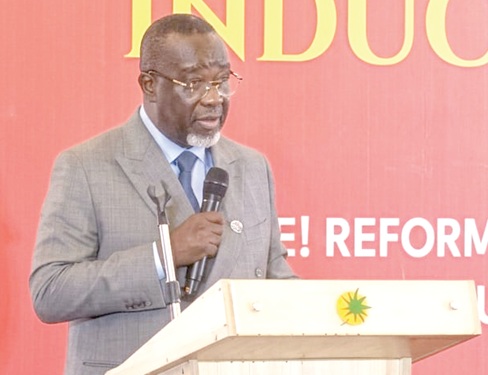
The Chief Justice (CJ), Justice Paul Baffoe-Bonnie, has urged the judiciary and insolvency practitioners to help save viable distressed businesses and only use liquidation as the last resort.
"Financial distress should not automatically lead to the death of an enterprise. Businesses with the potential to recover should be given the opportunity to do so to preserve jobs and protect investments," he said.
The CJ, who was speaking at an induction ceremony of the Chartered Institute of Restructuring and Insolvency Practitioners (CIRIP) Ghana, added that “the law should not hasten the death of an enterprise which proper intervention may yet save.”
The event, which formed part of activities marking the institute’s 20th anniversary, also saw the induction of more than 100 people into the profession after the successful completion of a masterclass programme.
The masterclass was organised to deepen participants' understanding of restructuring and insolvency practice, as well as the professional and ethical responsibilities of practitioners.
Justice Baffoe-Bonnie said the enactment of the Corporate Insolvency and Restructuring Act, 2020 (Act 1015), represented a significant change in the country's approach to insolvency.
He said whereas the traditional approach tended to focus on winding up companies that could no longer meet their obligations, the new framework encouraged stakeholders to consider whether a distressed business could be rescued.
The CJ said commercial justice should take into account the wider economic and social consequences of decisions concerning distressed businesses.
He then urged the judiciary to provide certainty, predictability and confidence in commercial matters, while remaining conscious of the economic realities surrounding cases before the courts.
Justice Baffoe-Bonnie also charged insolvency practitioners to combine technical competence with sound judgement, independence, integrity and courage.
He said practitioners had to distinguish between businesses that deserved a genuine opportunity to recover and those whose continued existence merely postponed an inevitable failure.
“Behind an employee’s salary is a family. Behind a creditor’s claim may be another business struggling to survive. Behind an investment may be someone’s lifetime of work and savings,” the CJ added.
Commitment
The President of CIRIP Ghana, Felix Addo, said the institute would continue to promote professional development and strengthen restructuring and insolvency practice in the country.
He said the institute, which began some 20 years ago as the Ghana Association of Restructuring and Insolvency Advisors (GARIA), had the objective of improving the treatment of distressed companies with the potential to recover.
"We are using this 20th anniversary to reflect on our achievements and challenges while preparing for the next phase of our development," the president said.
Mr Addo said the masterclass was a key activity in the anniversary celebrations and was designed as a practical working session to equip participants with the knowledge and skills required to operate as insolvency practitioners.
He added that a licensed insolvency practitioner had the authority under the law to undertake administration, restructuring, liquidations and receiverships, including management of assets in distress and acting as a trustee in bankruptcy
