
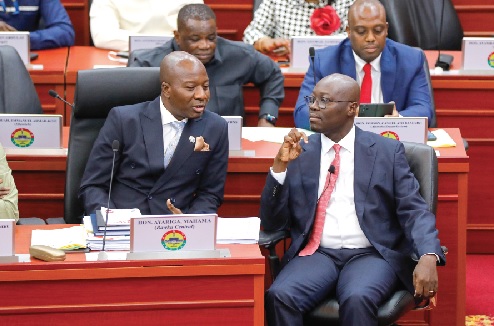
The Minister of Finance, Dr Cassiel Ato Forson, has attributed Ghana's ongoing economic recovery to deliberate policy decisions and superior economic management introduced by the current government rather than sheer luck.
Dr Forson insisted that the country's macroeconomic gains were driven by deliberate policy reforms rather than the International Monetary Fund (IMF)-supported programme or debt restructuring alone.
“Ghana's recovery is as a result of superior economic management,” Dr Forson told Parliament during the presentation of the 2026 Mid-Year Fiscal Policy Review in Accra yesterday.
He argued that while debt restructuring created fiscal space and the IMF programme provided a policy framework, neither could substitute for sound policy choices, fiscal discipline, effective implementation and political leadership.
Rather, he explained that the recovery had been anchored on three key transformational reforms introduced since the Mahama administration assumed office in January 2025, namely fiscal correction, the modernisation of Ghana's tax regime, and a complementary fiscal policy to support inflation targeting and exchange rate stability.
“The progress Ghana is recording today did not happen by chance. Some have suggested that our recent macroeconomic gains are simply the product of good fortune.
“Others have attributed the recovery solely to the debt restructuring programme or the IMF programme inherited in 2025. I firmly disagree. The sustainable economic recovery was built on good policy choices, competent economic management, disciplined execution and courageous leadership,” Dr Forson said.
The reforms
Dr Forson said the reforms had strengthened public financial management, restored fiscal credibility, improved revenue mobilisation, reduced fiscal risks and reinforced macroeconomic stability.
The minister stated that the fiscal correction programme strengthened expenditure discipline, restored debt sustainability and enhanced public financial management through measures, including amendments to the Public Financial Management Act, the establishment of the Fiscal Council and the Value for Money Office; tighter procurement controls and a commitment authorisation regime extended to state-owned enterprises.
He said the tax reform agenda abolished nuisance taxes, implemented comprehensive VAT reforms, introduced artificial intelligence-powered customs systems to improve compliance and revenue mobilisation, and revised the gold royalty regime.
He said the complementary fiscal policy centred on the establishment of the Ghana Gold Board to formalise gold trade, boost foreign exchange inflows and strengthen the cedi, alongside reforms to improve reserve accumulation and closer coordination between fiscal and monetary policy.
“The evidence before us is overwhelming. Ghana's recovery has been driven by a deliberate programme of economic reforms implemented since President Mahama assumed office in January 2025.
Economic turnaround
Dr Forson said the reforms had produced measurable improvements across all major macroeconomic indicators, demonstrating that the country's recovery was the result of disciplined policy implementation rather than favourable external conditions.
He said primary expenditure declined from 18.7 per cent of gross domestic product (GDP) in 2024 to 13.2 per cent in 2025, while the primary fiscal balance improved from a 2.9 per cent deficit to a 2.5 per cent surplus over the same period.
"These outcomes are not accidental. They are the product of reforms, discipline and sound economic management," he said.
The minister said the government had also shifted the IMF-supported programme from a revenue-led to an expenditure-led fiscal consolidation strategy to ensure a fairer distribution of the adjustment burden.
He maintained that the reforms had restored fiscal credibility, strengthened investor confidence and placed Ghana's public debt on a more sustainable path.
Macroeconomic targets
Dr Forson reaffirmed the government's macroeconomic targets for 2026, saying it remained committed to achieving overall GDP growth of at least 4.8 per cent, non-oil real GDP growth of 4.9 per cent, end-year inflation of eight per cent, plus or minus two percentage points, and a primary surplus of 1.5 per cent of GDP.
He said the government also aimed to maintain gross international reserves sufficient to cover at least three months of imports.
“These statements tell the story of where Ghana stood, where Ghana stands today, and where Ghana is heading," he told Parliament.
Lessons from the crisis
Dr Forson said the current administration had inherited an economy weakened by years of fiscal indiscipline, excessive borrowing, weak accountability and poor economic management.
He argued that the 2022 economic crisis was "not merely an accident" but the consequence of a series of wrong policy choices that undermined macroeconomic stability.
"The cedi depreciated at levels never seen before, inflation exceeded 50 per cent, investor confidence collapsed, and Ghana lost access to the international capital markets," he said.
The minister added that the debt restructuring programme imposed significant losses on domestic and external bondholders, while many financial institutions, pensioners and businesses also bore the cost of the crisis.
Never again
The minister said the government recalled those events not to dwell on the past but to remind Ghanaians of the consequences of fiscal indiscipline and economic mismanagement.
"These painful experiences must strengthen our collective resolve to safeguard macroeconomic stability and ensure that such a crisis is never repeated. Ghana must never be brought so low again," he said.
He added that the lessons from the crisis underscored the need for prudent fiscal management, transparency and sustained structural reforms to protect the economy from future shocks.
Expenditure controls
Dr Forson said the fiscal correction measures had sent a strong signal to Ghanaians, investors and development partners that fiscal discipline had become the cornerstone of the government's economic management strategy.
He explained that government had amended the Public Procurement Act to require commitment authorisation before procurement commitments were made, thereby linking procurement strictly to approved budgets and extending the framework to state-owned enterprises (SOEs).
"This reform firmly linked procurement to approved budgets and restored discipline to public expenditure management across government," he said.
The minister added that bringing SOEs under the commitment authorisation regime was necessary because their unchecked liabilities had contributed about three per cent of GDP to Ghana's public debt annually over the past decade.
