
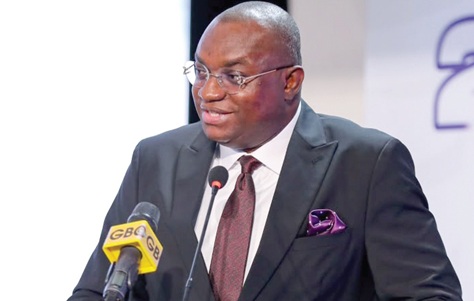
The Chief of Staff of the Office of the Presidnet, Dr Julius Debrah, has called for a stronger link between universities, government and industry to ensure that research conducted in the country translates into practical solutions, products, services and policies that improve lives.
He said the country did not lack ideas, research or innovation, but faced the challenge of moving promising ideas from universities and research institutions into practical use.
Dr Debrah said this in an address read on his behalf by the Presidential Adviser on National Resilience and Emergency Preparedness, Ernest Brogya Genfi, at the opening of the second Applied Research Conference of Accra Technical University (ARCATU) in Accra last Wednesday.
Dr Debrah said applied research must begin with clearly identified societal and national needs.
He said government and industry should engage researchers from the early stages of research to help identify problems that require attention, while researchers should involve the institutions and people who would eventually use their findings.
Dr Debrah also called for greater support for young researchers, including access to funding, facilities, reliable data and experienced mentors, to enable promising ideas to move beyond the research stage into working solutions.
The conference brought together researchers, academics, innovators, industry practitioners, policymakers, development partners and students.
Research
Dr Debrah said applied research was concerned with results and should have a clear connection to the lives of people and the development of the country.
He said the country needed to become better at taking knowledge generated in universities and placing it where it could make a difference.
“We must become better at turning research into products, services, businesses and some public policy,” he said.
He said research projects would sometimes require repeated testing, correction and improvement before becoming successful and, therefore, early difficulties should not automatically be regarded as failures.
University-industry
The Chief of Staff said although the country had held several meetings and signed agreements and memoranda between universities and industry, partnerships needed to move beyond formal ceremonies.
He called for collaborations that would lead to shared projects, practical training, access to equipment and support for promising ideas.
Dr Debrah said such partnerships should also allow students and researchers to work on real industry assignments while enabling businesses to improve their operations through research.
Shift
In an address read on his behalf by the Director of Innovations at the Ministry of Communication, Digital Technology and Innovations, Emmanuel Ofori, the sector minister, Samuel Nartey said the arrival of AI represented another major technological shift that required institutions to adapt.
He said academia, in particular, should take the lead in embracing AI and using it to strengthen research and innovation.
Mr George said AI should be treated as a decision-support tool rather than a substitute for human judgement.
He challenged universities to redesign curricula to equip graduates with skills that matched the changing needs of industry and the economy.
Academia
For his part, the Pro-Vice-Chancellor of ATU, Prof. Felix Kutsenadzie, said technical universities had a mandate to undertake applied research that contributed to the development of technologies and a skilled workforce for industry and the economy.
He said AI and other disruptive technologies were already changing how people worked, learnt, conducted research, delivered health care and managed businesses.
Prof. Kutsenadzie said AI itself could not guarantee sustainable and resilient development, stressing that its impact depended on how humans developed and applied the technology.
He urged researchers to ensure that innovations emerging from the conference were human-centred and responsible.
AI innovation
The Director-General of the Ghana Tertiary Education Commission (GTEC), Prof. Ahmed , urged the academic community not to wait until the use of AI became mandatory before embracing it in teaching and research.
He said AI presented significant opportunities to improve research, accelerate discovery, strengthen innovation and develop solutions to complex societal challenges.
