
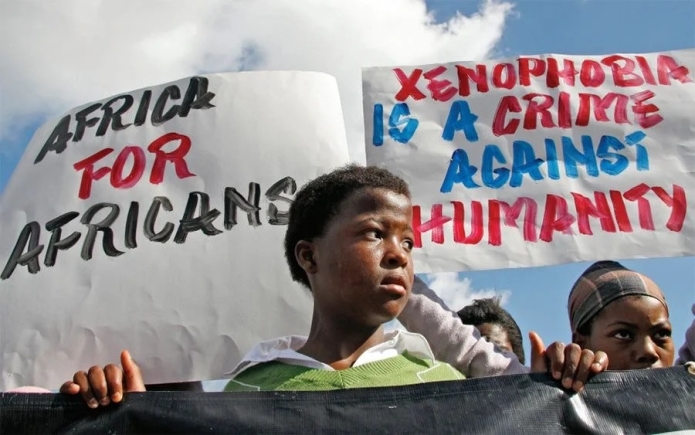
The recurring outbreaks of xenophobic violence in South Africa continue to trouble the conscience of Africa.
Each episode raises difficult questions about citizenship, economic competition, national identity, and the future of Pan-African solidarity.
Recent events, including the evacuation of foreign nationals and the debates that have followed, have once again brought these issues into sharp focus.
What is perhaps most disturbing is not merely the violence itself, but the narratives increasingly used to justify it.
In a recent media interview, a South African citizen reportedly questioned why foreigners should be allowed to settle so freely in South Africa.
He argued that during the anti-apartheid struggle, South African exiles lived in camps in neighbouring countries and were not permitted unrestricted integration into host societies.
He further complained that foreigners were taking jobs, businesses, and even girlfriends from South Africans.
Such arguments deserve careful examination.
The comparison between anti-apartheid exiles and present-day African migrants is historically flawed.
South Africans who fled apartheid were not merely housed in refugee camps. Across the continent, they benefited from the generosity and sacrifice of fellow Africans.
Nations such as Ghana, Zambia, Tanzania, Angola, and many others provided sanctuary, education, military training, diplomatic support, and political platforms from which the struggle against apartheid could be waged.
African governments and peoples embraced the South African cause as a continental cause. Their support was not based upon narrow calculations of national advantage but upon a profound belief that the freedom of one African people was inseparable from the freedom of all.
That history makes contemporary hostility towards fellow Africans especially painful.
Equally revealing is the complaint that foreigners are taking local girlfriends. Such rhetoric has little to do with immigration policy and much to do with insecurity, resentment, and the search for convenient scapegoats.
Throughout history, xenophobic movements have often been fuelled by claims that outsiders are taking what rightfully belongs to citizens—jobs, opportunities, homes, culture, and relationships.
These narratives are powerful because they simplify complex social problems into emotionally satisfying explanations. Yet they rarely lead to solutions.
The roots of social unrest are usually found elsewhere: unemployment, poverty, inequality, corruption, inadequate education, weak governance, and the failure of economic growth to improve the lives of ordinary citizens. When these problems persist, public frustration seeks an outlet. Foreigners become convenient targets because they are visible, vulnerable, and politically expendable.
Yet many immigrants contribute significantly to the South African economy. They establish businesses, create employment, provide essential services, and participate in commercial activities that sustain local communities. Like migrants throughout history, they seek opportunity, security, and a better future for their families.
Against this backdrop, the decision by some African governments to evacuate their citizens deserves thoughtful consideration.
Every government has a sacred duty to protect its nationals. When there is credible concern for their safety, prudence demands action.
Governments cannot wait for tragedy to occur before responding. Their first responsibility is not the preservation of diplomatic appearances but the protection of human life.
This explains why many Africans have viewed suggestions that governments should have delayed evacuation efforts with understandable scepticism.
While such opinions may stem from concerns about national image or fears of creating panic, they must be weighed against the immediate responsibility to safeguard citizens facing uncertainty and possible danger.
Equally troubling are reports that xenophobic attacks sometimes occur in the presence of law enforcement officers who appear unable or unwilling to intervene decisively.
Whether such perceptions are entirely accurate or not, they contribute significantly to fear among foreign communities.
When perpetrators believe that consequences are unlikely, violence becomes easier to organise and repeat.
Some observers have suggested that these developments reflect a broader political agenda. Others see them as spontaneous eruptions of public frustration. Whatever the explanation, history demonstrates that xenophobia seldom emerges in isolation. It thrives where economic anxiety, political rhetoric, weak institutions, and social frustration converge.
The tragedy extends beyond immigration policy.
It concerns the future of Pan-Africanism itself.
The generation that fought apartheid inspired the world with its vision of justice, reconciliation, human dignity, and non-racialism.
South Africa became a symbol of hope, proving that even the deepest divisions could be overcome through courage, sacrifice, and leadership.
Today, many Africans struggle to reconcile that inspiring legacy with recurring images of fellow Africans being harassed, assaulted, or forced to flee.
They remember a time when the continent stood united against apartheid and wonder how the descendants of those who benefited from continental solidarity can now regard fellow Africans as unwelcome intruders.
These are uncomfortable questions, but they cannot be ignored.
Can Africans continue to speak of continental unity while fellow Africans are treated as outsiders?
Can the sacrifices made during the liberation struggles be honoured while the spirit of brotherhood that sustained those struggles is gradually eroded?
Can Pan-Africanism survive if economic hardship repeatedly transforms neighbours into enemies?
History offers a sobering lesson. Nations rarely prosper by directing their anger towards convenient scapegoats. Sustainable progress is achieved through economic reform, effective governance, educational opportunity, social cohesion, and unwavering commitment to the rule of law.
The future of Africa will not be secured through exclusion and suspicion. It will be secured through cooperation, mutual respect, and a renewed recognition of our shared destiny.
For the struggle against colonialism and apartheid was never simply a political struggle. It was also a moral declaration that the dignity of one African is bound to the dignity of all Africans.
That declaration remains as relevant today as it was yesterday.
Epilogue: Under One African Sky
The African sky knows no borders.
The winds that cross the Limpopo do not carry passports; the rivers that flow to the sea recognize no tribe. The rains that nourish the veld, the savannah, and the forest make no distinction between native and stranger.
Yet man, who inherited one continent and one destiny, has learned to build walls where history built bridges and to sow suspicion where our forebears planted solidarity.
The challenge before Africa is therefore not merely to defeat xenophobia. It is to recover the brotherhood that once made strangers into comrades and neighbours into family.
For when one African is hunted because he is foreign, all Africa is diminished. When one African is denied dignity because of his origin, the dream of Pan-Africanism suffers a wound. And when fear triumphs over fraternity, the sacrifices of those who fought for Africa's liberation fade a little further into the shadows.
Let us remember that before colonial frontiers were drawn, before passports were stamped, before flags were raised, the peoples of Africa shared the same sun, the same rivers, the same hopes, and often the same blood.
May wisdom prevail over anger, justice over prejudice, and fraternity over fear.
Then perhaps future generations will inherit an Africa in which no man is hated for the place of his birth, no woman is threatened because of her nationality, and no child grows up believing that another African is an enemy.
For above us all stretches the same vast African sky — silent, enduring, and waiting for its children to remember that they are one.
