
Over the weekend, social media exploded with images from the call of over 1,500 men and women to the Ghana Bar.
The freshly minted ‘Esquires’ were in town, and they were not playing.
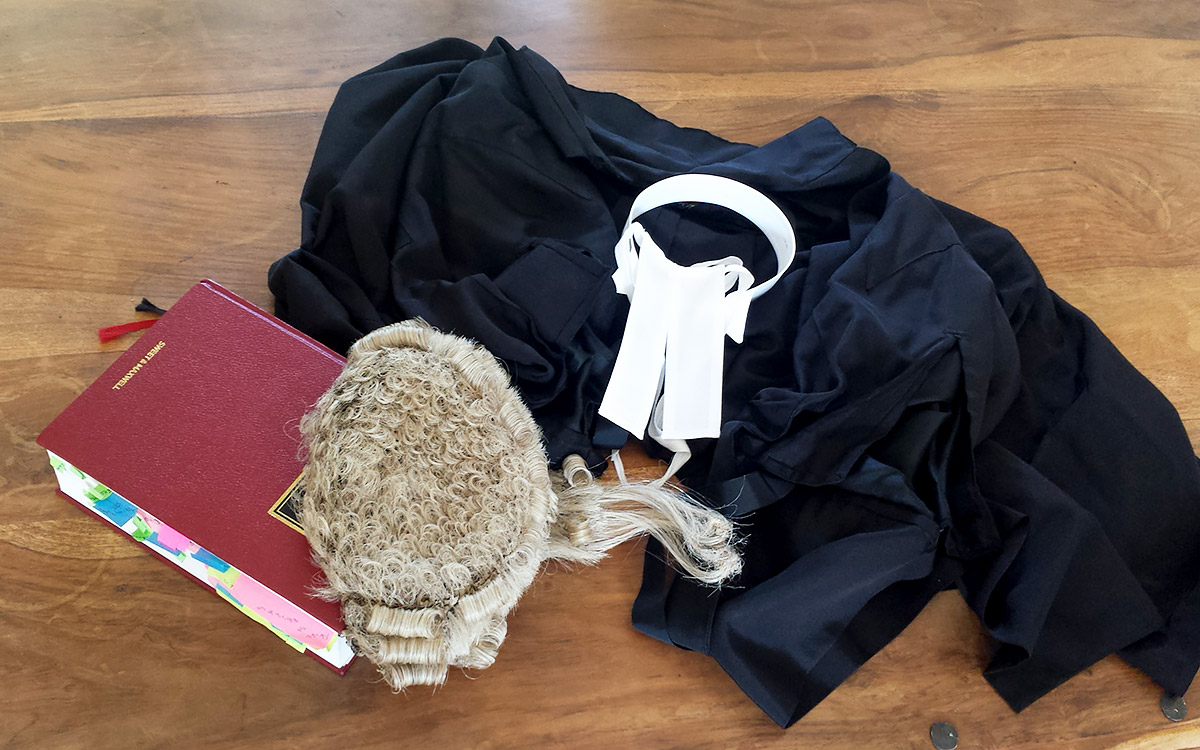
Smart suits were adorned with the billowing black gown, with the gleaming horsehair wigs perched atop heads and the white collar and bib to complete it all.
They strutted up to the stage to collect their certificates, bowing and beaming with smiles, to the delight of their families and friends in the auditorium.
Glamourous photoshoots adorned many a Facebook page, and the congratulatory messages came tumbling in.
The years of digesting complex, ancient case law, near-impenetrable court rules and procedure and Latin maxims had paid off.
They could now call each other ‘my learned friend’, almost as if anyone outside their hallowed circles is a stark illiterate and an ignoramus.
But not everyone seemed impressed.
Over 1,500 lawyers churned out in one year?
To do what?
Why is everyone rushing to read law as if it is a fashion trend?
Why are we not producing more engineers and scientists?
Oh, and those wigs, are they not a hangover from colonialism and do the lawyers not look ridiculous in them?
What is the fuss, really?
The purposeless lamentations, mostly recycled from previous years, kept rebounding.
Love-hate relationship
For some time, it has been easier to get through the proverbial eye of a needle than to get into law school for the professional stage of legal training, with the dreaded entrance examination serving as a fiery filter.
Many dreams have been catapulted into oblivion by frustration. Some have had to do a detour by going to The Gambia or Rwanda for that stage before returning to Ghana for the ‘Post-Call’ course in order to qualify to practise in Ghana.
Lawyers are both feared and respected, in almost equal measure.
For instance the Ghana Bar Association sticker on a vehicle is esssentially warning to wise traffic policemen with funny ideas, even if the temporary occupant is only a relative of the lawyer-owner and has never worn a legal wig in his or her life.
Beyond traffic checkpoints, the GBA car sticker is a magic key that opens several other doors.
For many, the last person to get into a dispute or a quarrel with is a lawyer, however minor the issue is.
The presumption is that you will be slammed with a lawsuit before you can scream ‘res ipsa loquitor!’.
When delivered in a certain tone, ‘I am a lawyer’, qualifies as a threat.
Many assume every worthy lawyer goes to court and that they simply use tricks and technicalities to defend criminals and get them off the hook.
No wonder some actually believe, in the 21st century, that when lawyers die, they are buried face down because God is upset with them.
Barbed lawyer jokes abound.
On the other hand, what could be more satisfying than boasting ‘my son/daughter/friend/concubine is a lawyer’, when someone wants to annoy you over the minutest of issues?
Indeed, law students in their first year of the undergraduate LLB programme are likely to be consulted by their relatives over minor disputes or issues and start getting addressed as ‘lawyer’.
Never mind that at that stage they literally know next to zero law and are grappling with the basic tenets of offer and acceptance in contract law, just as medical students regularly get consulted by family members for advice on minor troublesome ailments.
Glut of lawyers?
Do we really have a glut of lawyers, as some claim?
Does the number of lawyers we produce necessarily mean less attention is paid to engineers and other scientists?
At the College of Engineering of the KNUST alone, the student population stands at about 7,000.
The University of Ghana, UMaT and some other public universtities also provide engineering programmes, as do our technical universities.
Of course, the numbers called to the bar are comparable not to university engineering graduates, but rather those subsequently admitted to the Ghana Institute of Engineers as professional engineers.
But the point remains that we train huge numbers of engineering students each year.
In any event, the suggestion that science and law are mutually exclusive is a false narrative.
There are several legal specialisations to deal with every aspect of science or technology.
Nations are not built by science and technology alone.
They are also built by rules and lawyers are integral to the formulation of those rules.
How, for instance, can a road be built without the involvment of lawyers to draw up the contracts or secure land title, among others?
It is impossible to have systemic reforms without law.
Sneering at those in the legal profession who bring the law alive and make it work in literally every sector, for our collective good, is not smart.
Of course, as a developing nation, we need more engineers, doctors, and others, but we do not have to produce fewer lawyers in order to achieve that goal.
We actually need more lawyers.
As Chief Justice Baffoe-Bonnie stated at his vetting last year, “When measured against Ghana’s population, the ratio is roughly one lawyer to 7,000 citizens.
We are way below what is needed.
We actually need more lawyers,” According to Prof. Raymond Atuguba of the University of Ghana Law School, the acceptable lawyer-to-citizen ratio is one to 250.
The difficulty is that the overconcentration of lawyers in Accra, Kumasi and other big towns for obvious reasons gives the impression that the country is saturated with lawyers.
But Ghana is not Accra or Kumasi, and in parts of the country, access to legal services is a major challenge.
Beyond the popular misconception that a lawyer must necessarily go to court to be bona fide, expanding sectors, such as, mining, energy, banking and finance, maritime, shipping and other areas all require specialist legal expertise away from the courts, as do the public and private sectors as well as the judiciary and academia.
Let dreams prevail
Maybe the ‘cardinal sin’ of the members of the ‘I put it to you’ profession is that they have created, sustained and jealously guarded a certain aura around their profession through certain time-honoured traditions.
They have thus inspired admiration, respect and irritation in almost equal measure in a way that is absent from other worthy professions.
‘My learned friend’. ‘Counsel’. The 17th century English wig, the bib and the gown.
The latin and verbosity in making simple points.
The Bar conference. The razzmatazz around the call ceremony, given wings by social media.
Perhaps it is no surprise that increasingly, people are beating the door down to law faculties across the country, even when they are established in other professions and are unlikely to practise law upon graduation.
Let those who possess the passion, the acumen, the emtotional stamina and the pocket aspire and live their dream.
So what if law has become fashionable, so long as standards are high? Ghana will not collapse from the weight of more lawyers.
To those who have been called to the Bar this year, I offer my hearty congratulations.
Enjoy the noble profession and help make a difference to society.
Rodney Nkrumah-Boateng.
E-mail:
