
In Ghana, we love fanfare.
We also love words.
Fanfare has turned our Presidents into showboys, doing things pleasant to the eye of voters.
Words have an anesthetic effect on the people.
By the time we wake up, our anger has dissipated.
But not the cause of the anger.
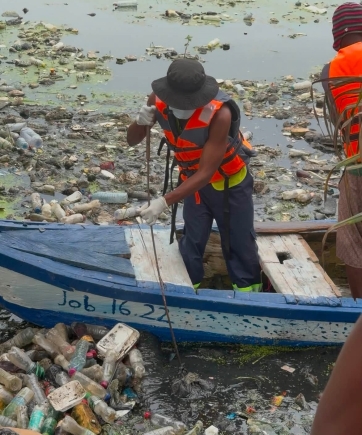
That is why we love to launch Sanitation Days; go to sleep, only to wake up, a few days later, to find ourselves still buried under filth.
On Saturday, September 6, 2025, President Mahama officially relaunched the National Sanitation Day.
Under his ‘Clean Ghana’ initiative, he said sanitation and cleanliness would now serve as key performance benchmarks for District Chief Executives (MMDCEs) “whose job security will be directly affected by the state of sanitation in their districts.”
A year on, drive along the Graphic Road and in front of the Kaneshie Market.
People now heap rubbish and leave it in the median, effectively telling the assemblies, “You say we should sweep, yes, we have swept.
Come and carry the heap away.”
The National Sanitation Day in Ghana was first declared in 2014. Long before then, J.J. Rawlings was descending into the gutters of Accra, desilting to rounds upon rounds of applause.
Within a fortnight, filth started piling up again like mountains and spreading like carpets.
Next was President Atta Mills. He promised to tackle the sanitation problem within his first 100 days in office. True, he did launch various localised clean-ups, but this effort was a drop in a large barrel.
Nana Akufo-Addo promised to make Accra the cleanest city in Africa.
The failure was as miserable as its effect was horrifying.
In the late 1980s, an Accra Mayor (a soldier by name, Colonel Okine) supervised the establishment of a compost plant at Teshie. Two years later, as Accra was brimming with filth, the plant was not functioning.
Readers may recall that some time ago, Zoomlion gave out free waste bins to households in Accra. What happened? People were using them to store water.
In the First Republic, Kwame Nkrumah placed waste bins everywhere.
The result? Read Ayi Kwei Armah’s report as captured in his book, ‘The Beautiful Ones Are Not Yet Born’:
“People did not have to go up to the boxes any more. From a distance, they aimed their rubbish at the growing heap and a good amount of juicy offal hit the face and sides of the box before finding a final resting place upon the heap”.
On GRIT sometime last year, a news item showed a woman who had been arrested for openly defecating behind the Cape Coast Castle. She looked (and sounded) offended.
Balefully, her eyes swept over the policemen from the caps on their heads to the soles of their boots and asked, genuinely surprised: “Ah, what is my offence? I am only ‘leaving’ my legs here” (a Fante idiomatic expression for defecation).
That woman is a representative of the 30 million Ghanaians who piss around anywhere.
She is the market woman, taxi or tro-tro driver, the kayayo or street seller who satisfies their thirst with sachet water and drops the empty plastic in the street or the gutter.
She is not pretending to be ignorant; she is genuinely surprised that there is a law against the act.
Have I made my point?
It’s simple: the battle is upstairs.
Filth is in the mind.
Only education can uproot it.
Strategy
On this same page a year ago, I shared a fact about the sanitation strategy adopted by Bangladesh to fight open defecation.
Instead of buying latrine pans, etc for the people, they hit upon a behavioural model called Community-Led Total Sanitation.
The intended effect was achieved. It triggered a collective shame and a shared desire for change.
Communities then self-organised to build their own low-cost, locally sourced toilets using bamboo and plastic rings.
The result: open defecation in Bangladesh plummeted from over 34 per cent in 1990 to less than one per cent by the mid-2010s.
Three lessons for Ghanaians.
One: the feat was achieved by a government that had no fear of losing votes in the next elections; Two, the government knew the value of think tanks; Three, they hit upon BEHAVIOUR CHANGE.
How often have we all, individually, not condemned the practice of heaping on the shoulders of our gutters garbage taken out during “National Sanitation Days”? Yet, come next Sanitation Day, all of us, you and I included, would be repeating this national habit.
I have not heard that a single Metro/Municipal or District Chief Executive (MMDCE) has been summoned, even for questioning in connection with the return of filth.
Contrast the speed with which the President acted on the report of visa racketeering in connection with the last World Cup.
The acting CEO of the National Sports Council was suspended.
There is a word for this environmental neglect. It’s called leaderlessness, a national tragedy in Ghana.
The writer is the Executive Director,
Centre for Communication and Culture.
E-mail:
