
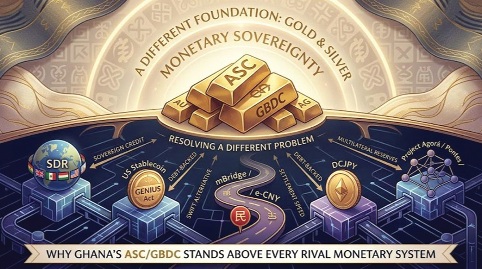
The global monetary order is in the middle of its most consequential rebuild since Bretton Woods, and almost nobody has noticed the one question every major power has quietly agreed not to ask.
The United States, through its stablecoin strategy, is racing to make the dollar faster.
China, through e-CNY and mBridge, is racing to make the renminbi independent of SWIFT.
Japan is tokenising yen deposits. Europe, through Project Agorá and its offshoots Pontes and Appia, is racing to make wholesale settlement programmable.
The IMF's Special Drawing Right sits in the background as the closest thing to a neutral multilateral reserve the postwar order has produced.
Every one of these systems is impressive.
Everyone is also, at its foundation, the same thing wearing different clothes: a claim on the credit and political will of a government or bloc.
None touches the deeper question: what should the reserve asset underneath global money actually be?
The Asset-Backed Stable Currency (ASC), conceived in Ghana as the monetary anchor of the Ashanti Financial and Industrial Protocol, is the only serious framework in the world today built to answer that question directly.
It does not need to outcompete the SDR, Agorá, Pontes, Appia, the US stablecoin regime, or China's e-CNY on their own terms.
It stands above all of them because it is solving a different and more fundamental problem than any of them were designed to solve.
Six systems, one avoided question
The IMF's SDR, built in 1969, is a basket of major currencies like the dollar, euro, yuan, yen, sterling with no intrinsic value of its own.
It is fiat squared, governed through quota shares set decades ago that still under-represent Africa's economic weight.
The US stablecoin strategy, formalised through the GENIUS Act, is Washington's defence of dollar hegemony: private issuers building dollar-backed tokens, engineering an estimated $1.9 trillion in fresh Treasury demand by 2030.
Brilliant statecraft.
Still a dollar, still backed by US government debt, still exposed to America's own fiscal trajectory.
China's e-CNY and mBridge represent the mirror strategy: state-issued digital currency, now paying interest since January 2026, moving across a settlement bridge that bypasses SWIFT.
Ninety-five per cent of mBridge's $55 billion in settled volume runs through the digital yuan renminbi with better plumbing, a sovereign liability that trading partners adopt by trading one external dependency for another.
Japan's DCJPY is a tokenised yen deposit, fully backed by currency already in Japan's banking system useful, domestic, not a reserve innovation.
Agorá, Pontes, and Appia, the BIS-convened tokenisation platforms, are the most technically sophisticated of the group.
They tokenise central-bank reserves and commercial-bank money to make settlement near-instant and programmable. But they were built to solve a European and G20 interoperability problem, and their reserve philosophy never leaves sovereign fiat.
They make the water move faster.
They never ask whether the water can be trusted.
Six systems, six governments and institutions, one shared assumption: that the reserve beneath global money must be a promise from a state, rather than something whose worth does not rise and fall with any single government's fiscal discipline, election cycle or sanctions exposure.
A different category, not another entrant
The ASC answers the question the other six were never built to ask. It anchors value in gold and silver assets that have functioned as trusted stores of value across every civilisation and every currency transition in recorded history, including the one that produced the dollar's own reserve status in 1944.
No SDR basket, no e-CNY, no GENIUS Act stablecoin, no Agorá-settled deposit can make that claim.
Each of them is a liability of someone.
The ASC is a claim on something.
This is not nostalgia for the gold standard. It is a structural argument about what belongs at the foundation of a monetary system built for a multipolar, digitally settled world.
Gold and silver do not carry a flag; they do not answer to Washington's debt ceiling, Beijing's five-year plans, or Brussels' interoperability mandates.
A nation holding ASC-denominated reserves is not exposed to another bloc's sanctions regime or credit downgrade the way it is when holding dollars, renminbi, or SDR claims.
Crucially, the ASC is digital by design, not digital as an afterthought, meaning it need not choose between commodity anchoring and the settlement speed Agorá, Pontes and Appia have spent years building.
It can sit on top of that infrastructure rather than compete against it, carrying a fundamentally different reserve asset across rails the world has already agreed are the future.
And it answers directly to African monetary sovereignty as its organising purpose, not a secondary benefit.
Every other system on this list was designed first to serve the power that built it, with African participation where it exists occurring on terms set elsewhere.
The ASC is the only framework among the seven conceived from the ground up, in Ghana, to serve African monetary independence as its first purpose.
Most importantly: the ASC does not need any of the others to fail. It is not betting the dollar collapses, mBridge stumbles, or Agorá fails to scale.
It makes the narrower, more durable claim that whichever rail technology wins the settlement race, the reserve asset carried across it still matters and that an asset independent of any single sovereign's credit is a stronger foundation than one that is not.
That is why it stands above the competition rather than in it.
Ghana as origin, not coincidence
That this framework originates in Ghana is not incidental; it is central.
A reserve philosophy built to serve monetary sovereignty carries more weight when designed by economies that have most acutely felt the cost of not having it: decades of currency volatility, external debt denominated in someone else's money, reserve composition dictated by institutions where African nations hold a fraction of the voting power their populations and growth trajectories would justify.
Ghana, with its own gold reserves and deep history in West African commodity trade, is a natural origin point for an instrument built on exactly the asset class that has defined its economic identity for generations.
The missing foundation
The honest comparison is not ASC versus SDR, Agorá, the dollar stablecoin regime, or e-CNY. It is the reserve layer versus the rail layer.
The other six systems, for all their sophistication, compete furiously over how fast sovereign fiat can move.
The ASC/GBDC is the only framework asking what should be moving in the first place and answering without needing permission from Washington, Beijing, Brussels, or the IMF's quota table.
That is why it does not compete with the rest. It stands above them.
