
There are moments when a song ceases to be a song.
It becomes a memory.
It becomes a prayer.
It becomes a bridge between who you were, who you have become, and the generations that will come after you.
That was what I witnessed at the MOBA MEGA GOSPEL EXPLO, held as part of the activities marking the 150th anniversary of Mfantsipim School.
As an old boy, I have attended many gatherings of Mfantsipim old boys: at reunions, funerals, anniversaries and social functions. I have watched boys who had not seen each other for decades embrace as though they had parted only yesterday.
But there was something different about this gathering.
Perhaps it was the music.
Perhaps it was the gospel.
Or perhaps it was the realisation that, after 150 years, the brotherhood forged on the Hill still has a voice.
I was not physically present at the venue, Harvest Chapel International, Tesano, but I was very much part of the gathering. I watched and actively participated online through the Mfantsipim@150 YouTube channel. Somehow, the distance disappeared. Through the screen, I felt connected to the old boys gathered at the venue, sharing in the worship, the music, the memories and the unmistakable Mfantsipim spirit.
The Ebusuapanyin was there. Members of the Executive Committee were there. The Executive Secretary was there. And, perhaps most importantly, old boys of different generations were there—young men and not-so-young men, each carrying his own Mfantsipim story.
Members of sister alumni associations were there too: Wey Gey Hey, Motown, Mansyte, Merries and Adisco. Their presence added another dimension to the gathering. The programme was co-MCed by Ms Shirley Tony Kum, a Mansyte chic, further reflecting the spirit of fellowship that has characterised the 150th anniversary celebrations.
Indeed, the presence of these sister alumni bodies was a reminder that the Mfantsipim@150 celebrations have taken on a national character. They are rooted in the history and traditions of Mfantsipim, but they have also become an occasion for alumni communities across the country to reconnect, celebrate shared values and affirm the bonds that exist among Ghana’s old secondary schools.
On stage were gospel musicians and ministers of the Gospel who themselves had passed through the portals of our great school. Among those who featured on the night were Nii Okai, Professor Addaquay, Yaw Antwi Dadzie, Jasher Taylor, Perez Musik and Joyful Way. Rev. Albert Ocran ministered the Word.
They sang, preached and worshipped, but somehow the evening became much more than a gospel concert.
It became a homecoming.
And then came the moment that, for me, captured everything.
We sang “For All the Saints” — The School Song
Something happens when Mfantsipim old boys sing together.
The years disappear.
The grey hairs disappear.
The professions, positions, titles and distinctions disappear.
For a few precious minutes, we are simply boys of Mfantsipim again.
The familiar words rose into the night, and I found myself thinking about all those who had walked before us.
The saints.
The old boys.
The teachers.
The non-teaching staff.
The headmasters.
The fathers and grandfathers who built institutions, raised families, served their communities and carried the Mfantsipim spirit into the wider world.
Some of them are no longer with us.
Yet they were present—in the memories we shared, in the traditions we inherited, and in the voices of the old boys who stood together.
As we sang, I could not help but think about the extraordinary journey of a school that has existed for 150 years.
One hundred and fifty years is more than an anniversary.
It is a procession of generations.
One generation takes the torch, carries it for a while, and then hands it over.
And perhaps that is why we sang “For All the Saints” as if we were possessed.
We were not merely singing about those who had gone before us. We were acknowledging that we are part of something larger than ourselves.
We are beneficiaries of a legacy.
And one day, we too will become part of the memory of Mfantsipim.
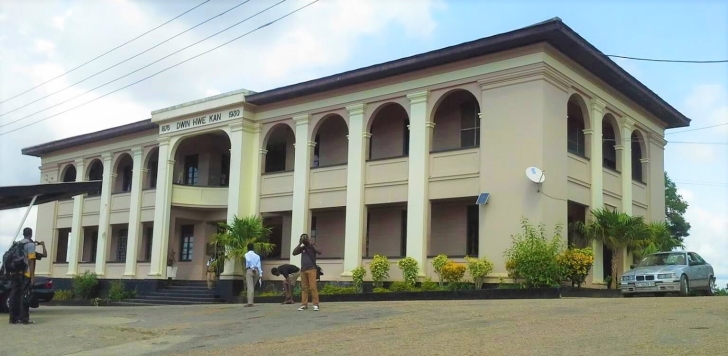
Then came “Dwen Hwe Kan.”
And if “For All the Saints” made us look back, “Dwen Hwe Kan” seemed to turn our eyes forward.
Thoughtfulness.
Foresight.
That familiar Mfantsipim motto suddenly sounded different in the context of 150 years.
Because what does it mean to tell a school that has survived for a century and a half to Dwen Hwe Kan?
It means that the work is not finished.
It means that nostalgia alone is not enough.
It means that the glory of yesterday must become the foundation for tomorrow.
As we sang the anthem, I looked around the virtual gathering and saw old boys who had spent decades carrying the Mfantsipim name into medicine, law, education, business, politics, the church, the military, academia and countless other fields.
And I thought: this is what Dwen Hwe Kan demands of us.
Not simply to remember where we came from, but to ask where we are going.
Not simply to celebrate the 150 years behind us, but to consider the generations ahead.
The beauty of the evening was that these two songs seemed to meet in the middle.
“For All the Saints” reminded us of those who had gone before.
“Dwen Hwe Kan” challenged us to look ahead.
Between the two was the Mfantsipim old boy of today—standing on the shoulders of those who came before him and carrying a responsibility to those who are yet to come.
And perhaps that is the real meaning of the Mfantsipim brotherhood.
We inherit.
We belong.
We serve.
We hand over.
At the MOBA MEGA GOSPEL EXPLO, the generations gathered under one roof, while old boys like me joined them virtually. But when the singing began, age, distance and circumstance became irrelevant.
The young old boy sang with the old old boy.
The man who left the Hill decades ago sang beside the man who left only recently.
Those at the venue sang alongside those of us following online.
Different houses. Different years. Different experiences.
One brotherhood.
One school.
One song.
One anthem.
For a moment, I closed my eyes and listened.
The voices were not perfectly uniform. They did not need to be.
There were voices carrying the strength of youth, voices softened by age, voices perhaps struggling to reach the notes they once sang effortlessly.
But together they created something beautiful.
The sound was bigger than any individual voice.
Just like Mfantsipim.
Perhaps that is what 150 years teaches us.
No single generation makes the school.
No single old boy owns the legacy.
We are custodians for a season.
Those before us did their part.
We have ours to do.
And those coming after us will have theirs.
So when we sang “For All the Saints,” I felt gratitude for those who built the road on which we walk.
And when we sang “Dwen Hwe Kan,” I felt responsibility—to make sure that the road we hand over is worthy of those who will walk it after us.
That night, the MOBA MEGA GOSPEL EXPLO became, for me, more than an event in the calendar of the 150th anniversary.
It became a reminder that Mfantsipim is not merely a place we attended.
It is a story we inherited.
It is a brotherhood we belong to.
It is a responsibility we carry.
And as the final echoes of the songs faded, one thought remained with me:
We sang for those who came before us.
We sang with those who stand beside us.
And we sang for those who are yet to come.
After 150 years, the charge remains unchanged:
Dwen Hwe Kan.
Think, and Look ahead.
And, as Mfantsipim boys have done for generations, fight as the saints who nobly fought of old.
By Philip Creech-Jones, MOBA ’92
- Read also
- Mfantsipim School @ 150 and Creech’s Mfantsipim Diaries: My First Shock
- Mfantsipim School @ 150 and Creech’s Mfantsipim Diaries: My second shock
- Mfantsipim School @ 150 and Creech’s Mfantsipim Diaries: Shock Number Three
- Creech’s Mfantsipim Diaries. My final shock
The writer is Philip Creech-Jones of MOBA 1992 (Mfantsipim Old Boys Association).
