


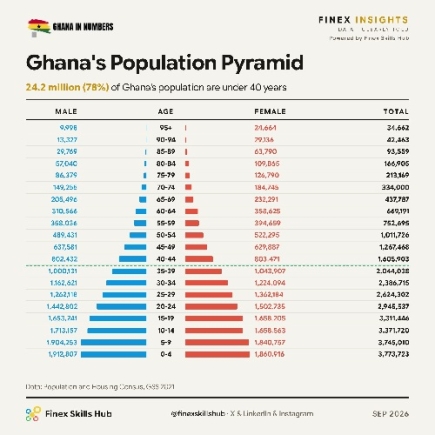
Look at Ghana's population pyramid and one thing jumps out immediately: it is wide at the bottom and narrow at the top.
That shape has a number attached to it, and the number is 24.2 million. That is how many Ghanaians, out of a total population of 30.8 million recorded in the 2021 census, are under the age of 40. In percentage terms, that is 78 per cent of the entire country.
Ghana, in other words, is a young nation. The question the numbers force us to ask is simple: Is that a gift or a ticking clock?
Why this matters now
Every year, hundreds of thousands of young Ghanaians finish school and start looking for work. The population pyramid tells us why that search is only going to get more competitive. The single largest five-year age group in the country is children aged 0 to 4, at 3.77 million. The next largest is 5 to 9, at 3.75 million.
Every band under 25 numbers in the millions. These children and teenagers are not a future problem. They are already on their way into classrooms, training centres and, eventually, the job market, in numbers far larger than the generations ahead of them.
This is what demographers call a "youth bulge". Handled well, with enough jobs, skills training and productive investment, it becomes what economists call a demographic dividend: a large working-age population driving growth, much like the shift that powered rapid growth in parts of Asia from the 1980s onward. Handled poorly, the same bulge becomes a source of youth unemployment and social pressure.
What the data shows
The Ghana Statistical Service's 2021 Population and Housing Census breaks the country's 30.8 million people into 5-year age and sex bands. A few patterns stand out.
First, the shape is genuinely pyramidal, not just wide at the base. The 2021 census shows Ghana's age structure is shifting from one dominated by children to one dominated by young people.
Between 2000 and 2021, the share of children aged 0 to 14 fell from 41.3 per cent to 35.3 per cent of the population, while the share of young people aged 15 to 35 rose from 34.6 per cent to 38.2 per cent. Ghana's youth bulge is moving up the pyramid, not disappearing.
Second, the working-age population, 15 to 64 years, makes up 60.4 per cent of the country, or roughly 18.6 million people.
For every 100 people of working age, there are 66 dependents, either children or people 65 and older.
That ratio, known as the age-dependency ratio, is a rough measure of how much economic weight each working adult is carrying.
Third, older Ghanaians remain a small share of the population. Only 4.3 per cent of the country is 65 or older. Ghana is not yet grappling with the ageing pressures facing many wealthier nations, but that will change eventually as today's large youth cohort moves up the pyramid over the coming decades.
Fourth, women slightly outnumber men nationally, 15.63 million to 15.20 million, a gap of about 437,000 people, or 2.8 per cent. This gap is more pronounced in urban areas and reverses slightly in rural areas, where men are marginally more numerous.
What it means for ordinary Ghanaians
For a parent, this data is a signal to plan early for school places and, later, for job opportunities, because the cohort behind their children is larger still. For a young jobseeker, it is a reminder that competition for entry-level roles will keep intensifying unless the economy creates jobs fast enough to absorb millions of new entrants over the next two decades. For policymakers, it is an argument for front-loading investment in education, vocational training and job creation now, while the dependency ratio is still relatively favourable, rather than waiting until the working-age population itself begins to age.
For businesses, it is simply a market signal. An economy where 78 per cent of the population is under 40 is an economy where consumer habits, digital adoption and labour supply will be shaped overwhelmingly by young people for a long time to come.
The FinEx verdict
Ghana is not short of people to build its future. It is short of time to prepare them for it. The size of the youth population is already fixed; what is not yet fixed is whether that generation finds classrooms, training and jobs waiting for them, or whether the pyramid becomes a pressure point instead of a springboard.