


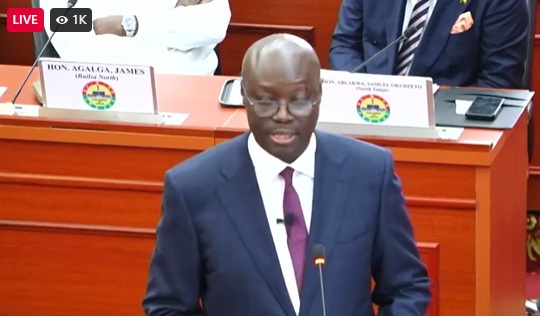
The Minister of Finance, Dr Cassiel Ato Forson, has outlined the eight foundational pillars that will underpin the government’s $10 billion New Economy programme, revealing a GH¢30 billion investment for 2027 and setting a target of 8 per cent real GDP growth.
Presenting the 2027 Budget in Parliament, Dr Forson stated that the government is shifting its economic philosophy to judge growth by the jobs and income it creates, rather than mere macroeconomic figures. "We will judge growth by the jobs it creates, the income it raises and the productive capacity it leaves behind.
Commodity windfalls and debt-financed consumption will no longer define our progress," he said.
The New Economy will be driven by eight pillars: macroeconomic stability and affordable finance; commercial agriculture, agri-industry and agribusiness; the oil palm value chain; energy sector reforms; critical minerals and value addition; cotton, textiles and garments; tourism, culture and creative arts; and pharmaceutical manufacturing.
To finance the programme, Dr Forson announced that the government will reduce the primary surplus target from 1.5 per cent to 0.5 per cent of GDP, alongside tax reforms and compliance measures. "In 2027, we will invest 1.5 per cent of GDP, equivalent to 30 billion Ghana cedis, in the New Economy," he stated.
Under the commercial agriculture pillar, which will receive $3 billion, the Minister outlined an aggressive push for food security. He announced that public procurement laws will be amended to require schools and hospitals to purchase locally grown food.
"The money of the Ghanaian people must create opportunities for the Ghanaian people. If you use Ghana's money to buy rice, you must buy Ghana rice," he stressed.
He added that commercial rice imports will be prohibited by the end of 2030. The government also plans to achieve self-sufficiency in sugar by 2030 and process 100 per cent of its cocoa locally by the same year.
In the energy sector, Dr Forson announced a decisive shift towards energy independence. He revealed that in December 2026, the President will cut the sod for a 1,450-megawatt state-owned thermal power plant at Kafuti Abrubano in the Central Region, alongside a 600-megawatt solar plant supported by 2,000 megawatt-hours of battery storage.
The government also aims to phase out all emergency power plants by 2030 and reduce the cost of power generation from 16 US cents to 8 US cents per kilowatt-hour.
Furthermore, the Minister disclosed that Ghana will invest $200 million in a 24-month nuclear readiness programme from January 2027 to December 2028, with the target of signing the engineering, procurement, construction, and financing contract for a fully state-owned nuclear baseload power plant by the end of that period.