


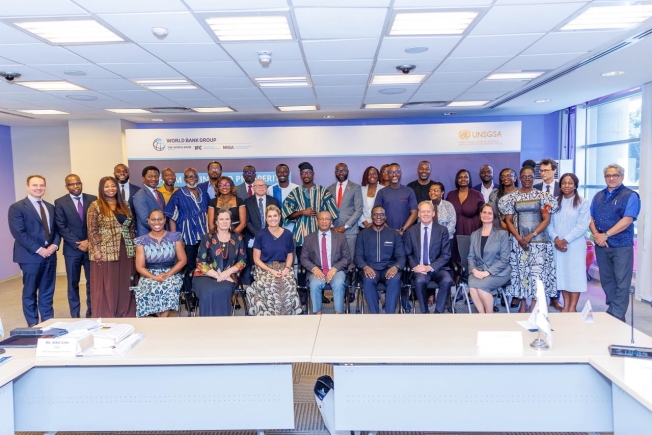
The World Bank Group has convened Her Majesty Queen Máxima of the Netherlands, the United Nations Secretary-General's Special Advocate for Financial Health, alongside senior representatives of government, regulatory institutions and the financial sector for a high-level roundtable on expanding savings opportunities, pension coverage and access to capital markets for informal-sector workers.
Held at the World Bank Group's Accra office under the theme "From Savings to Prosperity: Informal-Sector Pensions, Financial Health, and Capital Markets," the roundtable, organised jointly by the World Bank and the International Finance Corporation, explored practical approaches to strengthening household financial resilience while mobilising domestic savings for productive investment.
Ghana has made significant progress in expanding financial inclusion, with 81 per cent of adults holding a financial account in 2024, compared with 58 per cent across Sub-Saharan Africa, according to Global Findex 2025. Mobile-money access reached 78 per cent.
However, significant gaps remain in household financial resilience and retirement preparedness. Only 30 per cent of adults could cover more than two months of expenses following the loss of their main source of income, while just 18 per cent saved formally for old age.
Against this backdrop, Queen Máxima highlighted the importance of integrating savings, insurance, pensions and other financial services to help individuals move beyond account ownership towards greater financial security. "Financial access is a critical enabler, but we must also look at savings, insurance, pensions, and broader financial resilience," she said.
She emphasised that emergency savings are particularly important in sustaining long-term retirement contributions. "It is difficult to focus on retirement 30 years from now if you are worried about a financial emergency tomorrow," she said. She also underscored the commercial relevance of financial health, describing it as a business imperative rather than simply a corporate social responsibility concern.
Nathalie Kouassi-Akon, IFC Division Director for West Africa Gulf of Guinea, said the roundtable provided an opportunity to build on Ghana's progress in expanding financial access while addressing the remaining gaps in household financial security. "Financial inclusion, while essential, is not the finish line. The real measure of success is whether people are able to build resilience, withstand shocks and improve their financial wellbeing over time," she said. She further highlighted the importance of collective action involving regulators, pension providers, investors, financial institutions and innovators to identify scalable solutions and translate the discussions into practical commitments.
A central focus of the roundtable was the need to develop financial products that reflect the income patterns and circumstances of informal-sector workers, many of whom rely on irregular or seasonal earnings and remain underserved by conventional savings and pension arrangements. Participants explored opportunities to expand flexible micro-pension models that allow contributions on a daily, weekly, monthly, seasonal or lump-sum basis. Mobile-money platforms, agent networks and trade associations were identified as important channels for improving access and making regular saving more convenient.
The discussions also examined ways to broaden access to capital markets through safe, regulated and professionally managed investment opportunities, particularly for informal-sector and first-time investors. Ghana's three-tier pension system currently holds approximately US$11.5 billion in assets, although participation among informal-sector workers remains modest. Expanding coverage could strengthen the domestic institutional investor base and increase the pool of long-term capital available to support businesses and infrastructure development.
Through the Joint IFC-World Bank Capital Market Program, the World Bank Group is working with the Government to strengthen capital market foundations, diversify the institutional investor base and expand the supply of suitable investment assets. The World Bank Group is also supporting the development of Ghana's new financial inclusion strategy, which provides an opportunity to strengthen coordination across the financial sector and advance a more comprehensive approach to financial health.