


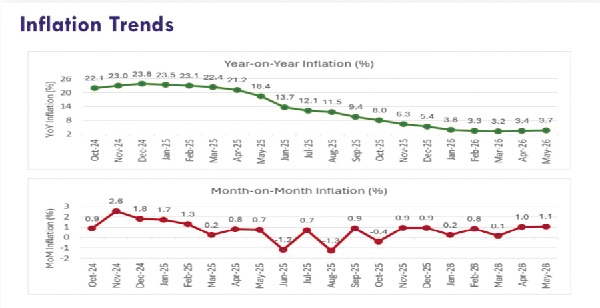
The President of the Peasant Farmers Association of Ghana (PFAG), Weipa Addo Awal, has called for timely access to fertiliser and stronger agricultural support systems as food price pressures pushed Ghana’s inflation rate to 3.7 per cent in May 2026.
He said delays in input supply and limited production support continued to affect farmers’ output, contributing to rising food prices across markets. He made the comments against the backdrop of new data showing a second consecutive monthly increase in inflation.
Ghana’s inflation rate rose from 3.4 per cent in April 2026 to 3.7 per cent in May 2026, according to the latest Consumer Price Index (CPI) report released by the Ghana Statistical Service (GSS).
The increase was driven largely by food inflation, which accelerated during the month.
Mr Awal said food inflation could ease if farmers were supported with the right inputs at the right time.
“If farmers received fertiliser on time, got adequate support and the rains were favourable, food production would increase, and that would help bring down food prices for consumers,” he said.
He said production challenges remained a major concern for farmers across the country.
“The best way to reduce food inflation was to support farmers with affordable inputs and ensure they had the resources to produce more,” he said.
The farmer added that consistent government support would help stabilise supply and improve the affordability of food items in local markets.
“Food prices would remain under pressure if farmers did not get timely access to fertiliser and other essential inputs,” he said.
Mr Awal further noted that agricultural productivity was closely linked to national price stability, especially for staple foods.
“Good rains alone were not enough. Farmers also needed affordable fertiliser and government support to increase production and stabilise food prices,” he said.
Inflation data
The Government Statistician, Dr Alhassan Iddrisu, said inflation increased from 3.4 per cent in April to 3.7 per cent in May, marking a continued but modest rise in the general price level.
He said the CPI rose from 260.5 in May 2025 to 270.2 in May 2026, indicating that goods and services were 3.7 per cent more expensive than a year earlier.
“Prices remained higher than they were a year earlier, but the pace of increase was much lower than what households experienced during the same period last year,” he said.
He added that inflation had declined significantly compared with May 2025, when it stood at 18.4 per cent, representing a drop of 14.7 percentage points over the 12 months.
He said while the longer-term trend remained downward, recent monthly increases suggested renewed pressure in some areas of the economy.
“The long-term trend remained downward, but recent data showed that prices had increased slightly in consecutive months,” he added.
Food prices
Food inflation rose from 2.2 per cent in April to 3.3 per cent in May, making it the main driver of the overall increase in inflation.
Food prices also increased by 2.0 per cent on a month-on-month basis between April and May, compared with the overall monthly inflation rate of 1.1 per cent.
Dr Iddrisu said food price movements had a strong influence on the overall inflation figure due to their weight in household spending.
“The data showed that food prices increased at a faster pace and contributed significantly to the overall inflation outcome,” he said.
He added that several food items recorded price increases during the month under review, reflecting supply-side pressures in the market.
According to the GSS, the average cost of goods and services purchased by households was 3.7 per cent higher in May 2026 than in the same month a year earlier.
The CPI increase from 260.5 to 270.2 reflected sustained upward movement in consumer prices, even though inflation remained lower than in previous years.
Dr Iddrisu said households were still experiencing higher prices compared with last year, but the rate of increase had slowed significantly.
“The data showed that price levels remained above last year’s figures, although inflationary pressure had eased compared with the previous year,” he said.
He noted that the reduction in inflation from 18.4 per cent in May 2025 to 3.7 per cent in May 2026 reflected a major decline in price pressures over the year.
The report showed that non-food inflation declined slightly to 4.1 per cent in May from 4.2 per cent in April, although non-food prices still rose monthly.
Inflation for goods increased to 1.4 per cent in May from 1.1 per cent in April, while services inflation rose to 9.9 per cent from 9.6 per cent.
Dr Iddrisu said services continued to record stronger inflation than goods.
“The data indicated that services maintained higher price increases compared with goods within the inflation basket,” he said.
Goods accounted for nearly three-quarters of the CPI basket, making their price movements particularly important in determining overall inflation trends.