


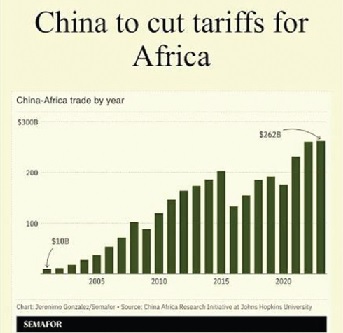
China's decision to grant zero-tariff treatment on imports from all 53 African countries with which it maintains diplomatic relations presents a significant opportunity for Ghana's export sector.
At a time when expanding export earnings, creating jobs and diversifying the economy remain national priorities, easier access to one of the world's largest consumer markets is a welcome development.
For Ghanaian producers and exporters, the policy has the potential to improve the competitiveness of selected products in the Chinese market and strengthen bilateral trade.
Yet the more important question is not whether China has opened its market, but whether Ghana is prepared to take advantage of the opportunity.
Tariff-free access, by itself, does not guarantee higher exports. Success will ultimately depend on Ghana's ability to produce competitively, meet international standards, understand market demand and build the institutional support needed to help local businesses succeed.
In other words, market access is only the beginning; export readiness is what will determine whether this policy translates into meaningful economic gains for Ghana.
The main barriers Ghana must address
The biggest obstacles, however, lie beyond tariffs. Ghanaian exporters must first be able to meet China’s quality, safety and sanitary requirements, especially for food and agricultural products.
This requires stronger testing, certification, traceability and closer coordination among producers, regulators and export-support institutions.

Scale and consistency are equally important. Chinese buyers will expect reliable volumes, uniform quality and timely delivery—conditions that many small producers may struggle to meet individually.
Producer aggregation, stronger cooperatives and investment in processing facilities will therefore be essential.
Ghanaian businesses must also understand the market they are entering. Products that succeed locally may require different packaging, labelling, branding and distribution strategies in China.
Without reliable market intelligence and partnerships with Chinese importers, even competitive products may struggle to reach consumers.
Logistics present another challenge. High shipping costs, limited cold-storage facilities and delays along the export chain can quickly erase the advantage created by zero tariffs. For perishable goods, efficient transport and cold-chain infrastructure are particularly important.
Finally, exporters need affordable finance to increase production, improve packaging, obtain certification and manage the long period between shipment and payment. Unless these practical barriers are addressed, zero-tariff access may remain more promising in principle than transformative in practice.
What government and exporters should do now
Ghana now needs a focused export response rather than a broad statement of intent. Government, working with exporters and industry associations, should identify five to 10 priority products with strong demand potential in China and build targeted market-entry plans around them.
This would allow limited resources to be concentrated where Ghana has the best chance of achieving early results.
Exporters will also need practical support to meet Chinese certification, safety and labelling requirements. Relevant public institutions should provide clear guidance, testing support and faster coordination so that businesses do not have to navigate complex standards alone.
Ghana’s embassy and trade representatives in China must play a stronger commercial role by providing timely market intelligence, identifying buyers and connecting Ghanaian producers with credible importers, distributors and retail platforms.
Trade promotion should move beyond exhibitions towards sustained business matchmaking and follow-up.
Access to finance must also improve. Exporters need working capital to increase production, complete certification, improve packaging and absorb shipping costs.
Smaller producers should be supported through aggregation arrangements that allow them to combine volumes, share logistics and meet large orders.
With a coordinated approach, zero-tariff access can become a practical export programme rather than remain a diplomatic announcement.
Conclusion
China’s zero-tariff policy creates a useful opening for Ghana, but the policy itself will not deliver export growth.
The outcome will depend on how quickly Ghana strengthens production, standards compliance, logistics, market intelligence and export finance.
The opportunity should therefore be treated as part of a broader national export strategy, not as an isolated trade concession.
Ghana must focus on products it can supply competitively, support firms to meet market requirements and build stronger commercial links with Chinese buyers.
The real test is no longer whether the Chinese market is open. It is whether Ghana is prepared to enter it with the right products, at the right quality, and at the scale required to compete.
The writer is the Executive Director, Africa-China Centre for Policy & Advisory (ACCPA)
Email: