
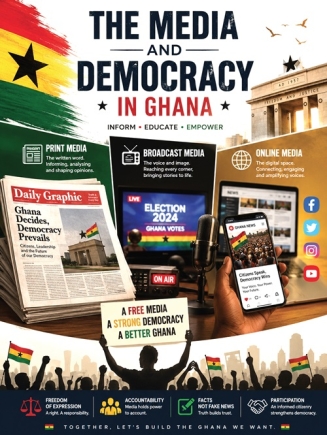
Ghana's political space has undergone significant liberalisation.
Constitutional guarantees of fundamental freedoms have opened civic life to broader citizen participation.
Nowhere is this more visible than in the media landscape, which has transformed dramatically from an era dominated by a single state broadcaster to a thriving landscape of private television and radio stations.
Citizens today enjoy a far richer and more diverse information environment as a result of the transition to multiparty democracy.
More importantly, this pluralism has made government action — particularly conduct that undermines democracy — subject to scrutiny from multiple independent sources, making it far harder for poor governance to go unnoticed.
It is now commonplace for the media to investigate and expose acts of corruption; report and amplify findings from civil society governance reports; collaborate with advocacy groups on anti-corruption and good governance campaigns; and produce documentaries that lay bare policy failures in areas such as illegal mining.
A further benefit of this liberalisation has been the growth of local radio stations broadcasting in indigenous languages, which has helped close the longstanding information gap between urban and rural communities.
In 1999 (Afrobarometer Round 1), 56 per cent of urban dwellers cited radio as a daily source of news, compared to just 34 per cent of rural dwellers.
By 2024 (Afrobarometer Round 10), that urban figure had edged down to 49 per cent, while rural listenership grew meaningfully to 42 per cent- a convergence that reflects the expanding reach of local-language broadcasting across the country.
Liberalisation has not come without its costs. Chief among them is the growing phenomenon of misinformation and disinformation, which has become a fixture of political competition, turbocharged by technology.
The paradox is a striking one: the same technological forces that have democratised access to and dissemination of information have also ushered in an era of rampant misinformation and disinformation, particularly during elections.
The media itself has not been immune — at times functioning less as a gatekeeper of facts than as an unintended conveyor belt for falsehoods.
Nonetheless, the role of the media remains critical.
Which is why public perceptions of the media paint a troubling picture, raising serious questions about its capacity to serve as a reliable democratic safeguard.
The consequences of poor public perceptions
In Afrobarometer Round 10 (2024), only two out of ten (15 per cent) expressed “a lot” of trust in news from public media institutions.
This remained unchanged from the Round 8 (2019) survey, where the same percentage expressed the same level of trust in public media institutions.
The sentiment is no different for private media institutions, where in Round 10 (2024) the level of trust was the same and unchanged from Round 8 (2019).
In addition to the low level of trust is the perception of media corruption.
In Round 10 (2024) only one out of 10 Ghanaians (Eight per cent) said “none” of the people in both public and private media institutions are involved in corruption.
This is worrying because it suggests that Ghanaians perceive a lot of media corruption.
Low trust and high perceptions of corruption are not the only reputational burdens Ghana's media must contend with.
In Afrobarometer Round 8 (2019), seven in ten Ghanaians (69 per cent) believed that news media and journalists "sometimes or often spread information they know to be false".
How can an institution weighed down by this three-pronged crisis — low public trust, widespread perceptions of corruption, and a belief that it deliberately peddles misinformation — credibly serve as a reliable democratic safeguard?
The answer is not that the media cannot serve as a reliable democratic safeguard — it can and does — but that doing so has become increasingly difficult.
That difficulty is precisely why institutional reform within the media itself is a critical next step, one that must directly confront and counter the eroding public confidence in it.
Where should reform begin? A good starting point is editorial standards and accountability.
Media houses must develop clear editorial standards, communicate them openly to the public, and enforce them consistently.
Of particular importance is how outlets handle errors.
When incorrect information is reported, a retraction is not enough — it must be both swift and prominent, commanding the same reach and visibility as the original story.
A quiet correction buried at the bottom of a webpage or read out briefly at the end of a broadcast falls far short of the accountability the public deserves.
Ghana's democracy needs the media — of that there is little doubt.
A functioning democracy requires informed citizens, and informed citizens require a media they can trust to report accurately, independently, and in the public interest.
And as the Afrobarometer data makes clear, Ghanaian citizens have serious reservations about the media they currently have.
Rebuilding that confidence is, therefore, central to the future of Ghana's democracy itself.
The writer is Director,
Democracy Project
