
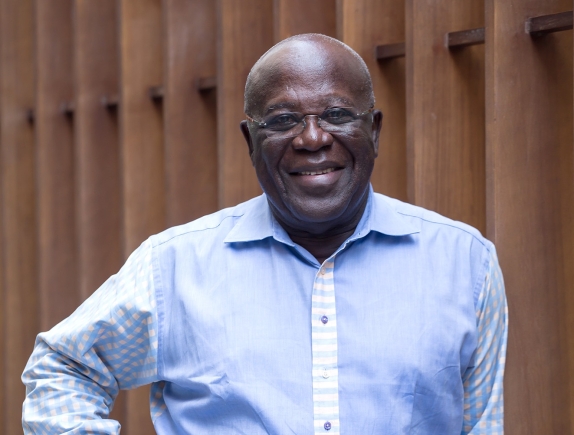
While General Ignatius Kutu Acheampong’s 1976 Union Government project collapsed under the weight of authoritarian overreach and intense civic resistance, Sir Sam Jonah’s contemporary blueprint deliberately seeks to distance itself from military-era coercion.
Addressing the Kutu Acheampong Memorial Lectures, Sir Sam emphasised that his vision of a consensual government of national unity would operate strictly within the democratic parameters of Ghana’s Fourth Republic.
Read also: End four-yearly electoral wars: Sir Sam Jonah proposes new Union Government (Part 1)
Rather than abolishing political parties or suspending the regular electoral calendar, his framework proposes a time-bound, eight-year transitional arrangement spanning two parliamentary terms.
Enacted through a two-thirds parliamentary majority and ratified by citizens in a national referendum, the model preserves presidential term limits and multiparty competition, while redefining electoral victory as a mandate for inclusive national stewardship rather than unilateral state capture.
In framing his intervention this way, Sir Sam attempts to rehabilitate the core philosophical premise of consensus governance—long associated with indigenous Ghanaian political traditions—without replicating the repressive apparatus that doomed Acheampong’s Supreme Military Council five decades ago.
Is Jonah’s blueprint constitutionally feasible?
From a strictly legal standpoint, Sir Sam’s proposal is constitutionally permissible insofar as it relies upon established amendment procedures rather than extra-constitutional rupture.
However, translating his vision into binding law confronts formidable procedural and structural hurdles embedded within the 1992 Constitution.
Under the Fourth Republican dispensation, constitutional provisions are divided into non-entrenched and entrenched clauses, each governed by distinct amendment thresholds.
While non-entrenched provisions may be altered under Article 291 through a two-thirds parliamentary majority following consultation with the Council of State, restructuring the core architecture of executive authority, ministerial appointments or parliamentary representation inevitably triggers the stringent safeguards of Article 290.
Amending entrenched provisions – which govern the Executive, the Legislature and the Representation of the People – requires not only parliamentary supermajorities, but also a national referendum achieving a minimum of 40 per cent voter turnout and at least 75 per cent approval from participating voters.
Equally problematic is the potential erosion of institutional checks and balances.
Ghana’s constitutional design relies heavily on a distinct Parliamentary Minority to scrutinise executive expenditure, vet public appointments and hold the government to account.
Absorbing the principal political parties into a unified governing coalition risks hollowing out formal parliamentary opposition, thereby blurring the separation of powers and weakening domestic mechanisms of democratic oversight.
Entrenched duopoly and political realities
Beyond intricate constitutional mechanics lies the far steeper obstacle of political feasibility within Ghana’s entrenched two-party system. Since the return to constitutional rule in 1992, the National Democratic Congress (NDC) and the New Patriotic Party (NPP) have alternated in office within a fiercely competitive duopoly that has rightfully earned Ghana international acclaim as a beacon of peaceful democratic consolidation in West Africa.
Yet, this very stability of alternation has reinforced a deeply rooted, patronage-driven political culture in which electoral victory confers near-total control over thousands of state appointments, public procurement contracts and state-owned enterprises.
Within such a zero-sum political economy, political parties function primarily as organisational vehicles for capturing state power to reward loyalists and regional constituencies.
Consequently, neither the ruling party nor the official opposition possesses a compelling rational incentive to dismantle a system from which each expects to benefit cyclically every four or eight years.
Moreover, securing a 75 per cent referendum mandate in an electorate deeply polarised along partisan, regional and socio-economic lines appears exceedingly remote.
Given that voter turnout and electoral behaviour in Ghana are overwhelmingly driven by partisan mobilisation, should either the NDC or the NPP perceive a unity arrangement as detrimental to its electoral ambitions, its capacity to rally grassroots opposition would almost certainly defeat the proposal at the ballot box.
Furthermore, by explicitly invoking the controversial label of ‘Union Government’, Sir Sam’s proposal carries heavy historical baggage; for many civil society actors, professional associations and older citizens, the terminology remains inextricably linked to past authoritarian efforts to neutralise legitimate political opposition.
A catalyst for incremental reform?
Ultimately, the enduring significance of Sir Sam Jonah’s intervention may lie less in the literal adoption of a formal Union Government and more in its capacity to jolt Ghana’s political class toward meaningful institutional reform.
Comparative evidence from consociational and power-sharing experiments across sub-Saharan Africa – such as transitional unity governments in Kenya and Zimbabwe – suggests that absorbing rival political elites into a single cabinet frequently replaces healthy democratic scrutiny with elite collusion, inadvertently shielding corruption and maladministration rather than curing them.
Nevertheless, by spotlighting growing popular disillusionment with the socio-economic dividends of Fourth Republican democracy, Sir Sam has reopened an urgent national conversation regarding the structural pathologies of winner-takes-all politics.
Even if a wholesale transition to a power-sharing cabinet remains politically improbable within the current partisan equilibrium, sustained pressure from respected statesmen, traditional authorities, and civil society organisations could compel the NDC and NPP to embrace more attainable institutional compromises.
These include legally binding long-term national development plans that prevent incoming administrations from abandoning ongoing infrastructure projects, constitutional amendments to curtail excessive presidential appointment powers and broader bipartisan representation on independent state governance bodies.
Read also: End four-yearly electoral wars: Sir Sam Jonah proposes new Union Government (Part 1)
The writer is Emeritus Professor of Politics, London Metropolitan University and Professor Extraordinarius, University of South Africa.
