
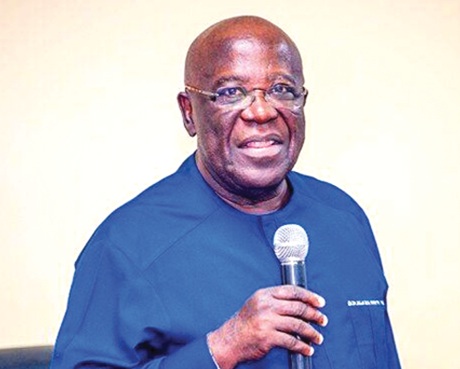
Speaking recently at the Kutu Acheampong Lectures on the theme ‘Breaking the Silence: The Human and Political Complexities Behind the Leadership of General Acheampong’, prominent business executive and philanthropist, Sir Sam Jonah, proposed a fundamental restructuring of Ghana’s Fourth Republican constitutional order.
He advocated a consensual government of national unity to replace the country’s entrenched ‘winner-takes-all’ electoral model, arguing that post-1992 politics has degenerated into a zero-sum struggle that undermines developmental continuity and institutional integrity.
Signalling his support for democracy over authoritarianism, Sir Sam framed his proposal as an institutional recalibration designed to align democratic governance with Ghana’s socio-economic realities.
To substantiate his critique of Ghana’s contemporary political economy, Sir Sam cited empirical data from a 2024 Afrobarometer survey.
These findings showed that while roughly 75 per cent of Ghanaians affirm democracy as the preferable system of governance, fewer than half are satisfied with its practical delivery, and the share of citizens willing to entertain non-democratic alternatives has doubled since 1999.
Contending that this democratic deficit stems from structural flaws within an imported adversarial framework rather than a rejection of popular sovereignty, he noted that widespread poverty compromises voter autonomy.
Poverty, he asserted, turns ballots into commodities traded for immediate material inducements – such as bags of rice and sugar, cooking oil and party-branded T-shirts.
In addition, socio-economic opportunities remain unevenly distributed in Ghana, and electoral campaigns may gravitate toward ethnic, regional, or religious cleavages instead of programmatic debates.
The result, according to Sir Sam, is that state power changes hands like a dropped relay baton: incoming administrations abandon flagship infrastructure projects simply because they bear a rival party’s imprint, and development progress is stymied.
The return of Union Government?
By delivering his remarks at a forum focusing on the late General Ignatius Kutu Acheampong, Sir Sam directly confronted one of the most contentious episodes in Ghana’s post-colonial history.
In the mid-1970s, amid severe economic contraction and widespread allegations of state corruption – epitomised by the 1975 ‘Briscoe Scandal’ involving senior military figures – Acheampong’s Supreme Military Council sought to stabilise its rule by proposing a ‘Union Government’ (UNIGOV) in October 1976.
General Acheampong’s UNIGOV envisioned a non-party, tripartite power-sharing arrangement comprising the military, the police and civilians.
However, civil society, university students, and professional bodies – most notably the Association of Recognised Professional Bodies and the People’s Movement for Freedom and Justice – widely viewed the initiative as a thinly veiled attempt to entrench military hegemony under the guise of indigenous consensus.
Following a heavily contested March 1978 referendum marred by state media monopoly, the detention of opponents and widespread allegations of electoral manipulation, the regime claimed a 54 per cent victory.
Rather than securing legitimacy, the aftermath triggered acute political instability, culminating in Acheampong’s removal in a July 1978 palace coup led by his deputy, General Fred Akuffo, who accused him of running the state as a ‘one-man show’.
Rejection of military involvement in government
Explicitly distancing his proposal from Acheampong’s top-down, military-imposed UNIGOV, Sir Sam insisted that modern national unity must be anchored in constitutional legality, multi-party legitimacy, and popular consent.
Outlining a six-pillar institutional blueprint to operate within the existing electoral calendar, he acknowledged that transition to a new union government would require an Act of Parliament passed by a two-thirds supermajority and ratified by the electorate in a free, transparent referendum.
In his framework, presidential and parliamentary elections would proceed normally under the Electoral Commission (EC), but winning would confer the right to lead rather than own the state.
Every political party securing at least 10 per cent of parliamentary seats would be entitled to a proportional share of the 19-member Cabinet, meaning a party with 40 per cent of seats would receive roughly eight ministerial portfolios.
Additionally, the leader of the second-largest party would automatically become Senior Minister with a statutory seat at the table.
Ministerial nominees would be chosen by their respective parties and vetted by Parliament, with the President empowered to reject a nominee only for good cause, while Cabinet composition as a whole would be mandated to reflect Ghana’s regional diversity.
To safeguard policy continuity and democratic checks, he proposed that political parties and Parliament enact a legally binding National Development Compact prior to the unity period, establishing measurable targets in agriculture, energy, industry, skills and infrastructure based on the National Development Planning Commission's long-term plan.
Projects within this compact would be insulated from partisan cancellation, and heads of public boards and agencies would serve fixed, merit-based terms unaffected by election outcomes.
Finally, Jonah stressed that horizontal accountability must remain intact, proposing that Parliament's Public Accounts Committee be chaired by a member outside the governing coalition, while fundamental rights, term limits, press freedom and the independence of the EC remain strictly inviolable.
State viability over partisan supremacy
Drawing on corporate boardroom governance – where rival directors set aside personal animosities to sign company accounts for the enterprise's survival – Sir Sam challenged Ghana’s political elite to prioritise state viability over partisan supremacy.
In the second part of this article, I will examine the political feasibility of the new union government proposal.
The writer is Emeritus Professor of Politics, London Metropolitan University, and Professor Extraordinarius, University of South Africa
