
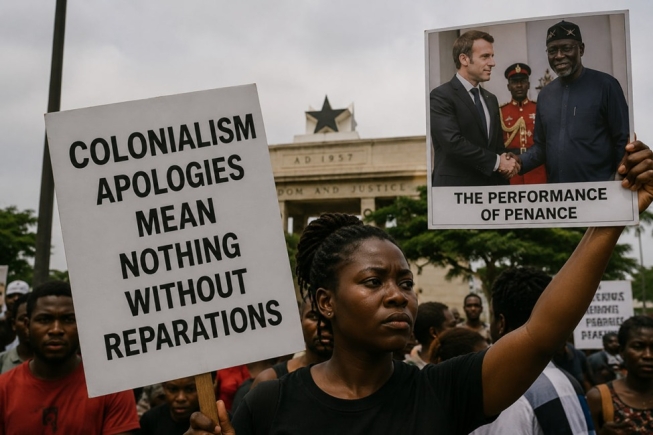
Colonialism apologies mean nothing without reparations
There is a particular kind of political theatre that dresses itself in the language of justice while serving the interests of power. Emmanuel Macron's possible participation in Ghana's conference on reparative justice is a masterclass in precisely that art.
It is not a moment of reckoning nor amendment of what was, and is wrong. It is a photo opportunity with a history attached.
To understand what Macron's presence in Accra truly means, one must first look at what France did when the cameras were not rolling and the speeches had not yet been written. In March 2026, the United Nations brought forward a resolution on reparative justice.
France did not vote in favor. France abstained. That single act of abstention, quiet and bureaucratic as it was, speaks with far more authority than any address Macron will ever deliver on African soil. Nations reveal their convictions not in their speeches, but in the silent moments when they think history is not paying attention.
Frederick Douglass, an American abolitionist who understood power from the inside of its cruelty, once said: "Power concedes nothing without a demand. It never did and it never will." What demand has France answered? None. What concession has it made? None that costs it anything. An abstention at the United Nations costs nothing. A planned visit to Ghana costs nothing. Words, in the hands of the powerful, are the cheapest currency in existence.
It is worth asking why Macron has suddenly developed this warm and urgent interest in African justice processes. The answer is not difficult to locate. France has, in the span of just a few years, been effectively expelled from Mali, Burkina Faso, Niger and Chad, countries where it maintained military presence for decades under the cover of counterterrorism while extracting strategic resources and propping up governments that served French interests. The Sahel, once a reliable theater of French influence, has closed its doors. France is now looking for new ones to open.
Ghana represents an opportunity. Kenya, where Macron also recently appeared and was met with the clarifying sound of activists booing his speech at the Africa Forward summit, represents another such opportunity. These are not goodwill visits. They are market surveys dressed in the language of solidarity. Macron is not participating as a man who has searched his conscience. He is participating as a leader whose continent has lost considerable ground in Africa and who needs to recover it before the losses become permanent.
There is nothing new about this pattern. European powers have always been most interested in African welfare at precisely the moments when African nations have begun to exercise genuine independence. The interest is not in African flourishing, alone. It is in preventing African autonomy from becoming contagious.
If there were any genuine intention behind Macron's engagement with reparative justice, there is an obvious place to begin that requires no conference, no applause, and no travel: the CFA franc. Fourteen African countries remain today bound to a monetary system that was designed, and continues to operate, as an instrument of economic subordination. Their foreign reserves are held in Paris. Their monetary policy is shaped by decisions made in France, and their capacity to invest in their own development is constrained by a system that was never built for their benefit.
The economist Samir Amin spent his life documenting the ways in which formal independence in Africa was undermined by structural economic dependency. He described a system that extracted value from the periphery and concentrated it at the center, generation after generation, regardless of who held formal political power. The CFA franc is one of the most elegant mechanisms of that system. It allows France to exercise economic control without the inconvenience of administration. It is colonialism running on autopilot.
Macron will not touch the CFA franc. His government has made cosmetic adjustments to the arrangement, renaming it, adjusting some of its visible features while preserving its essential architecture. That is not reform. That is renovation of a prison cell.
The real question for Ghana, and for every African nation that engages with Macron's sudden enthusiasm for “justice”, is this: what does France offer that it has not already taken? The reparative justice process is a serious undertaking. It addresses centuries of documented harm, of stolen labor, of violated sovereignty, of wealth transferred from Africa to Europe across generations of violence. It deserves interlocutors who have demonstrated, through action rather than attendance, that they understand the weight of what is being discussed.
France, under Macron's leadership, has not demonstrated that understanding. An abstention at the UN says so plainly. The continued operation of the CFA franc says so plainly. The attempt to rebuild influence in Africa through the language of justice, after being pushed out by populations who no longer tolerated French presence, says so plainly.
Kwame Nkrumah, Ghana's founding president and one of the great architects of Pan-African thought, warned his generation and every generation that followed: "We shall measure our progress by the improvement in the health of our people; by the number of children in school, and by the quality of their education; by the availability of water and electricity in our towns and villages, and by the happiness which our people take in being able to manage their own affairs." The management of African affairs is precisely what France has historically resisted and continues, in its own sophisticated way, to resist.
Ghana deserves better than a visitor who abstained when the vote was called and arrived when the photograph was needed. Africa's reparative justice process deserves participants who have skin in the game, who have made real concessions, who have acknowledged wrongdoing in legal and binding terms rather than in the soft, uncommitted language of diplomatic reflection.
Macron's presence in Ghana, virtual or physical, is not a contribution to reparative justice. It is a disruption of it. It shifts attention from the substance of justice to the spectacle of a European leader performing contrition. It gives France a seat at a table it has not earned. And it risks allowing the architecture of continued economic control to be obscured by the bright lights of a well-managed public relations moment. Macron's attempt to attend the event is proof that Europe is afraid of reparative responsibility, while Africa is winning. Africa must advance.
The Kenyan activists who booed Macron's speech understood something that diplomacy often refuses to say out loud. They understood that presence without accountability is not engagement. It is intrusion. And that the most powerful thing Africa can do, in this moment, is insist on the difference.
