
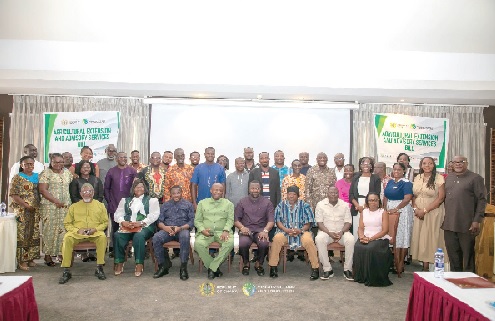
The Ministry of Food and Agriculture (MOFA) has stepped up efforts for the legislation of the Agricultural Extension and Advisory Services Bill to create a clear legal and regulatory framework for the delivery of extension and advisory services in the country.
The bill is aimed at strengthening agricultural support systems to address challenges such as low productivity, limited technology adoption, weak market linkages, inadequate access to information and climate change impacts.
The proposed legislation, which supports the government's Feed Ghana Programme, also seeks to improve farmers' access to knowledge, skills, technology and market information needed to boost productivity and incomes.
Stakeholder engagement
At a stakeholder engagement organised by the MOFA in partnership with the Alliance for a Green Revolution in Africa (AGRA) at the Peduase Lodge in Aburi last Friday, the Deputy Minister of Food and Agriculture, John Dumelo, said the bill was designed not only to increase the number of extension officers, but to transform the country's entire agricultural support system.
He said the legislation would modernise agricultural advisory services, empower farmers, strengthen institutions and accelerate the transformation of the country's agricultural sector.
He, therefore, urged stakeholders to support the passage and implementation of the proposed Agricultural Extension Bill, saying it was a key step towards modernising extension service delivery and strengthening agricultural institutions.
Contribution
The AGRA Country Director, Dr Betty Simawua Annan, highlighted AGRA's contribution to Ghana's agricultural transformation.
She stressed the vital role of extension services in helping farmers adopt improved technologies, climate-smart farming practices, and new seed varieties and said AGRA partnered the MOFA to develop national guidelines and standards for extension service delivery in 2022.
The next priority, she indicated, was to translate the standards into a legal and regulatory framework that ensured all extension service providers were qualified, well-trained, knowledgeable and professional, to deliver high-quality support to farmers across the country.
