
Welcome to Tafi Atome Monkey Sanctuary and Cultural Village,” a metallic signpost embossed with the picture of the colourful Mona monkey gave an indication that we had reached our destination.
It was on Wednesday, July 1, 2026. The atmosphere at Tafi-Atome, a farming community of about 1,500 people, was filled with the harmonious melody of chirping birds, humming insects and whooping monkeys.
Tucked away in the lush, rolling hills of the Afadjato South District in the Volta Region, the 360-hectare sacred forest that straddles the green community is not merely a tourist destination; it is a profound testament to the symbiotic bond between humanity and nature.
Even before the site guide at the Tafi-Atome Monkey Sanctuary, Robert Dzandu, took us through the visitors’ protocols, every member of the travelling team was on tenterhooks.
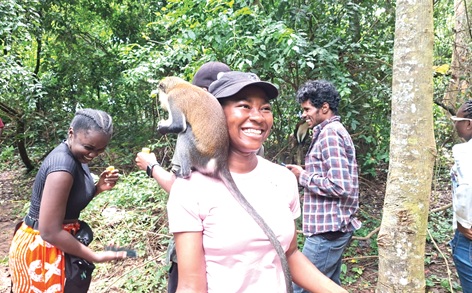
As custom demands, each member of the team was handed a finger of banana, with the instruction to hold firmly to it for a good experience with the Mona monkeys.
Even before we navigated our way through the serpentine footpath that leads into the dense forest reserve, dozens of monkeys were licking their palms in readiness for the bananas.
Their predominant medium-sized bodies, characterised by striking long tails, grey-brown coats, and distinct white markings on their brows and rump, gave the sanctuary an imposing aesthetic value.
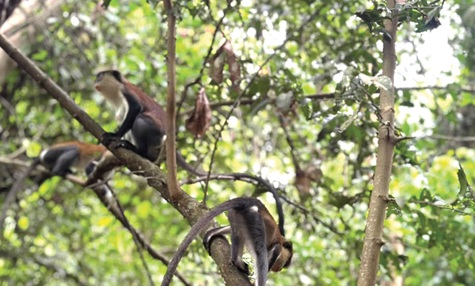
With effortless grace, the Mona monkeys started their aerial display.
They launched themselves across the narrow gaps between tree branches, limbs outstretched in perfect arcs, defying gravity with a fluidity that speaks to immense mastery.
Ostensibly, the primates were sending a clear message that "if you put good things in our mouths, we would dance well for you".
As we interacted with the monkeys, I reflected on the ample stories that have been told about the friendly nature of the Mona monkeys (Cercopithecus mona), a virtue that has solidified their bond with the local community.
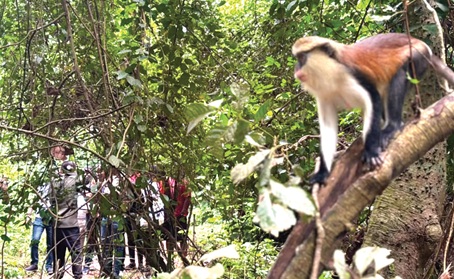
The skilful tree animals are ever ready to grab a banana from a visitor
However, beside this beautiful story is the fact that their relationship with humans is tied to the banana. As long as you have your banana firmly in your hand, you are sure of enjoying the partnership of the clingy monkeys. However, their loyalty ends when the banana is gone.
Tradition and science
The site guide at the Tafi-Atome Monkey Sanctuary explained that historically, the monkeys have been considered messengers of the gods, for which reason they are protected under traditional taboos.
For that reason, hunting them is strictly forbidden, and their deaths are mourned with the same solemnity as a human passing.
It is also believed that those who harmed the monkeys or acted against the forest face spiritual consequences.
As a result, residents have developed a respectful relationship with the monkeys and allow them to move freely within the community without interference.
The 360-hectare forest reserve hosting the monkeys is a critical piece of the sub-equatorial forest ecosystem that serves as a natural corridor, providing essential services.
As frugivores, the monkeys play a pivotal role in forest regeneration by dispersing seeds through their droppings, which sustains the diversity of the local flora.
Again, the ecological site plays an important role in regulating the microclimate as the dense forest cover maintains local humidity and temperature levels, which is crucial for the surrounding agricultural lands.
An associate professor at the Centre for Climate Change and Sustainability Studies (C3SS) at the University of Ghana, Prof. Yaw Agyemang Boafo, explained that sacred forests act as carbon sink, helping to mitigate the localised effects of climate change.
Prof. Boafo added that conserved forests contribute to environmental stability by influencing local rainfall patterns and maintaining cooler conditions.
“People must understand that beyond the ecological benefits of sacred forests, there are livelihood aspects where it serves the needs of the community,” he said.
Mr Dzandu confirmed that assertion, explaining that the sacred forest at Tafi-Atome had helped to improve rainfall patterns.
“Even during the dry season, we still experience more rainfall compared to neighbouring communities that have cleared their forests,” he said.
Again, he indicated that apart from providing a home for monkeys, the forest also helps to stabilise the environment and protect the community from harsh weather events.
“Recently, a strong storm caused about seven large trees in the forest to fall. If that storm had directly hit the community, the damage could have been severe; but the forest helps to protect the community from such impacts,” he added.
Sustainability
Despite the enormous benefits of the monkey sanctuary, the natural resource faces persistent environmental threats.
As the local population grows, the demand for farmland increases, putting pressure on the forest boundaries.
The challenge with this development is that if the forest shrinks, the monkeys lose their natural food sources, forcing them to venture into human settlements, which increases the risk of conflict and disease transmission.
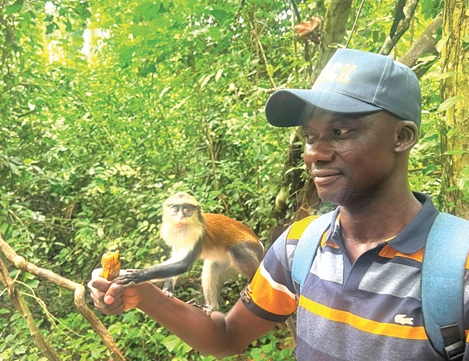
The reporter had the fine experience of interacting with the monkeys
Also, climate change has caused unpredictable rainfall patterns, impacting the productivity of the fruit trees that sustain the monkeys.
Mr Dzandu explained that although rainfall generally does not negatively affect the sanctuary, it was bedevilled by challenges including heavy storms, wildfire invasion, and predatory pythons.
“The community has taken responsibility for maintaining the forest because it is an important source of income.
During the dry season, we create fire belts around the forest to reduce the risk of bushfires.
When there is a fire outbreak near the forest, both men and women in the community come together to control the fire.
Protecting the forest has become part of our daily responsibility because it supports the livelihoods of the people,” he said.
While government support for the sanctuary is limited, Mr Dzandu said non-governmental organisations (NGOs) have contributed to conserving the resource through research activities.
“Researchers visit regularly to study the monkeys, monitor their health and assess possible disease risks.
These annual research activities help improve understanding of the monkeys and support continued conservation efforts,” he added.
For his part, Prof. Boafo stressed that there must be more convergence of traditional and scientific knowledge to help conserve the monkey sanctuary and leverage its ecological, cultural and social values.
“We are in a crisis as far as climate change is concerned, and we need all forms of knowledge on board to deal with it. The eco-tourism module at Tafi-Atome must be replicated across the country,” he said
Conclusion
Tafi-Atome stands as a beacon for community-based conservation.
It proves that the preservation of biodiversity does not require the exclusion of local people, but rather their active participation.
By valuing the "sacred" status of the monkeys, the community has successfully monetised their heritage without destroying the very assets they protect.
Just as the loyalty of the monkeys at Tafi Atome is tied to the banana, so is nature’s loyalty to humanity heavily dependent on how people and communities respect the environment and protect it from destruction.
It reminds us that when we choose to protect the wild, the wild, in turn, sustains us socially, economically, and spiritually.
As Ghana looks toward a more sustainable future, the whispers of the Mona monkeys in the Tafi-Atome canopy offer a blueprint worth following.
Writer’s email:
