
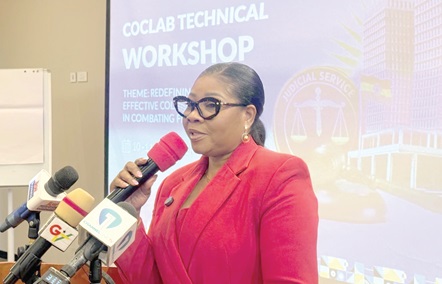
The Second Deputy Governor of the Bank of Ghana (BoG), Matilda Asante-Asiedu, has said that the country must close outstanding gaps in its anti-money laundering and counter-terrorist financing framework to avoid a return to the Financial Action Task Force (FATF) grey list, which could raise the risk and cost of doing international business for Ghanaian financial institutions.
She explained that a poor assessment could affect correspondent banking relationships as international financial institutions could reassess their exposure to Ghana, potentially making cross-border payments and other international transactions more costly and subject to greater scrutiny.
The task force had previously warned that the loss of correspondent banking relationships can hinder trade, increase financial exclusion and push transactions towards informal channels.
The Deputy Governor said such implications could extend to remittance flows, investment and Ghana's wider integration into the global financial system.
Opening a technical workshop at Senchi in the Eastern Region last Thursday, Mrs Asante-Asiedu urged member institutions to remain fully engaged and work together to close the outstanding gaps ahead of the mutual evaluation.
“We need to ensure that all the gaps that have been identified are closed; we must work together to protect the integrity of Ghana’s financial system," she said.
Background
The two-day workshop was organised by the Coordinated Council on Law Enforcement and Anti-Money Laundering (COCLAB).
The formation of COCLAB in the country was spearheaded by the Bank of Ghana, building on INTERPOL’s 1988 Resolution to help curb economic crime around the world.
The workshop was on the theme: “Redefining COCLAB as an effective collaborative body in combating financial crime.”
It sought to strengthen inter-agency collaboration, improve information sharing and enhance coordinated efforts to prevent, detect and combat financial crime in Ghana.
Digital threats
Mrs Asante-Asiedu said the changing financial crime landscape required institutions responsible for combating it to shift their strategies and mindset to keep pace with emerging threats.
She said fraud incidents in the digital space increased by 98 per cent between 2022 and 2025, confirming that criminal activities were increasingly following the growth in digital transactions.
The Deputy Governor further explained that fraud involving payment service providers (PSPs) could transcend individual institutions because PSP accounts were held with banks, thereby exposing the wider financial ecosystem to risks.
She also said that mobile money and fintech transactions were increasingly interconnected, making collaboration among regulators, financial institutions and law enforcement agencies critical to identifying and mitigating risks.
Mrs Asante-Asiedu said intelligence-led operations against illegal online operators in parts of Accra in 2023 resulted in the arrest of 430 people, including three foreign nationals.
She, however, said that COCLAB had strengthened action against unlicensed financial institutions through enhanced surveillance, enforcement, arrests and prosecutions, while improved information sharing had supported successful prosecutions within the banking sector.
Collaboration
A Justice of the Court of Appeal, Justice Afia Serwah Asare-Botwe, urged institutions involved in financial crime cases to work closely with the courts and understand the requirements of the judicial process.
She said such collaborations were necessary to ensure that cases brought before the courts were properly prepared and handled without creating misconceptions or prejudicing proceedings.
