
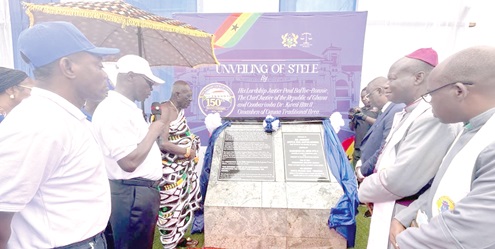
The Judiciary Services has outlined plans to redevelop the historic West Africa Court of Appeal (WACA) building in Cape Coast into a museum and research centre as part of efforts to preserve its legacy and boost tourism in the city.
Speaking at the unveiling of the stele as part of activities to mark the 150th anniversaryof the Judiciary, the Chairman of the Judiciary at 150 Planning Committee and a Justice of the Supreme Court, Justice Richard Adjei Frimpong, said the facility carried a significant historical value, having once served as the appellate court for the Gold Coast, Sierra Leone, The Gambia and Nigeria.
He explained that following independence and the establishment of national appellate courts across West Africa, the WACA building lost its original judicial function and had since remained in ruins.
According to him, the Judiciary was now considering a redevelopment plan that would transform the structure into a museum and research centre to preserve its historical relevance and promote academic and legal research.
"This building has a different historical background. It served as the West African Court of Appeal for the entire sub-region. After independence, it became redundant, and for some time now it has been underutilised," he said.
Justice Adjei-Frimpong noted that the redevelopment formed part of the Judiciary's 150th anniversary agenda, adding that discussions were ongoing with traditional authorities in Cape Coast on how best to enhance the facility.
He disclosed that proposals under consideration include adding accommodation facilities to enable researchers, students and visitors to stay and engage more deeply with the site's historical and judicial significance.
"We are engaging the traditional authorities to see how we can expand it beyond a museum into a full research and tourism hub. That way, Cape Coast will gain another important heritage asset," he added.
He stressed that the project would not convert the facility back into a court, but rather reposition it as a heritage centre to complement Ghana's judicial history and strengthen Cape Coast's tourism appeal.
He expressed hope that the Judiciary's 150th anniversary celebrations would deepen the bond between the people of Cape Coast and the judicial system, noting that the initiative was intended to honour the past while building a stronger future for justice delivery in Ghana.
Receiving the proposal, the Omanhen of the Oguaa Traditional Area, Osabarima Kwesi Atta II, welcomed the initiative and expressed the readiness of the traditional council to support the Judiciary in any collaborative effort to preserve and develop the historic site.
He said the WACA building remained an important symbol of Cape Coast's legacy and gave an assurance that the traditional authorities would work closely with the Judiciary to ensure its transformation benefits the community and the country as a whole.
The redevelopment of the WACA facility forms part of the Judiciary's broader 150th anniversary programme aimed at highlighting the institution's historical roots while modernising justice delivery infrastructure across the country.
Historical
The West Africa Court of Appeal (WACA), located at Bakano in Cape Coast, served as the highest appellate court for the British West African territories of the Gold Coast (now Ghana), Nigeria, Sierra Leone and The Gambia from 1928 until 1957.
It heard civil and criminal appeals from the superior courts of the four territories before final appeals proceeded to the Judicial Committee of the Privy Council in the United Kingdom (UK).
WACA ceased operations as the territories gained independence, beginning with Ghana in 1957. The building remains an important symbol of the country's judicial heritage and the evolution of the rule of law in West Africa.
