
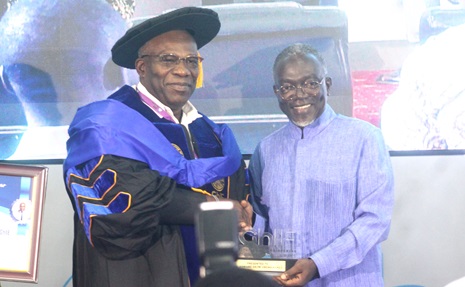
The Chief Executive Officer (CEO) of the Volta River Authority (VRA), Edward E. Obeng-Kenzo, has disclosed that the VRA is modernising generation facilities, improving operational efficiency and expanding renewable investments to meet future energy demands and requirements to support the 24-Hour Economy policy.
He cited the need for battery storage, smart grids and digital monitoring to support continuous industrial operations.
“The integration of renewable energy, battery storage systems, intelligent grid management and digital control platforms will become increasingly important in supporting continuous industrial operations.
These technologies will help to ensure that power truly never sleeps,” he said.
Mr Obeng-Kenzo was speaking at the Ghana Institution of Engineering’s (GhIE) Second Professor Douglas Boateng Lecture Series titled: “Power Never Sleeps: VRA, The 24-Hour Economy and the Industrial Future of Ghana" in Accra last Thursday.
The lecture was attended by a host of engineers and dignitaries, including Rev. Dr Joyce Rosalind Aryee, who chaired the occasion; the GhIE Executive Director, Dr Enyonam Kpekpena; the Vice-President of GhIE, Dr Patrick Bekoe; the President-elect of GhIE, Sophia Abena Tuani; and the President of GhIE, Ludwig Annan Hesse, who participated virtually.
Reliable energy
The VRA CEO said reliable energy drove industrial production, value addition and job creation, and was also central to regional integration through the West African Power Pool.
He identified key constraints holding back the sector as high energy costs, revenue shortfalls, low renewable penetration, infrastructure gaps and system losses.
Mr Obeng-Kenzo said the success of the government’s 24-Hour Economy and Accelerated Export Development Programme would depend largely on reliable, affordable and available electricity.
He stated that power was the bedrock for the continuous operation of factories, hospitals, data centres and industrial parks, without which they could not operate continuously.
“The 24-Hour Economy programme's Production Transformation pillar is particularly relevant to this gathering because it focuses on developing competitive and climate-resilient production systems, strengthening agricultural value chains, and establishing industrial corridors with reliable infrastructure,” Mr Obeng-Kenzo said.
He indicated that while the programme sought to transform the country from an import-dependent and raw-material exporting economy into a productive, value-adding and globally competitive one, “there is one indispensable requirement for achieving them — electricity”.
Role for engineers
He challenged GhIE to lead in three areas, namely enforcing national engineering standards and reducing system losses; providing strategic engineering leadership and policy input, and advancing long-term institutional thinking through foresight planning and professional development.
“Ghana's 24-Hour Economy presents a unique opportunity to accelerate industrial growth, create meaningful employment, increase exports and strengthen national prosperity.
But this transformation can only be achieved if it is powered by reliable, affordable and sustainable energy,” he said.
“Just as the Volta River continues to flow day and night, season after season, so too must our commitment to powering Ghana's development remain unwavering. People may rest, but progress cannot sleep, neither can power,” he said.
VRA’s contribution
Mr Obeng-Kenzo said for 65 years, VRA has remained at the centre of the country’s energy development.
Starting with hydro at Akosombo and Kpong, the authority later pioneered thermal generation with the Takoradi Thermal Power Station and the Tema Thermal Power Complex, and has since moved into solar with projects in Lawra, Navrongo, Kaleo and Pwalugu.
“Altogether and with 65 years of providing reliable electricity for our customers in Ghana and in the West African sub-region, we have powered economies with the current total generation capacity of 2,547 megawatts and counting,” he said.
He added that VRA had consistently led each new phase of energy development, paving the way for private sector participation, while relying on a Ghanaian workforce of engineers and technical staff.
